
If you have ever stood in front of a pump catalog or a stack of supplier quotations wondering whether an open or closed impeller belongs in your system, you are in good company. The question looks simple. The answer, as most engineers discover, depends on a handful of variables that no single comparison table captures completely. This article walks through those variables, from the structural differences you can visualize to the casting-sourcing details that most guides stop short of covering.
Open vs. Closed Impeller — Structural Differences
Before any performance number matters, you need a clear mental picture of what separates these two designs. Think of a desktop fan with exposed blades spinning in open air. That is the rough intuition behind an open impeller. Now imagine those same blades sealed inside a flat, disc-shaped housing with only a center inlet and an edge outlet — that is a closed impeller. The analogy is not perfect, but it sets the right expectation for what follows.
Open Impeller Design and Flow Characteristics
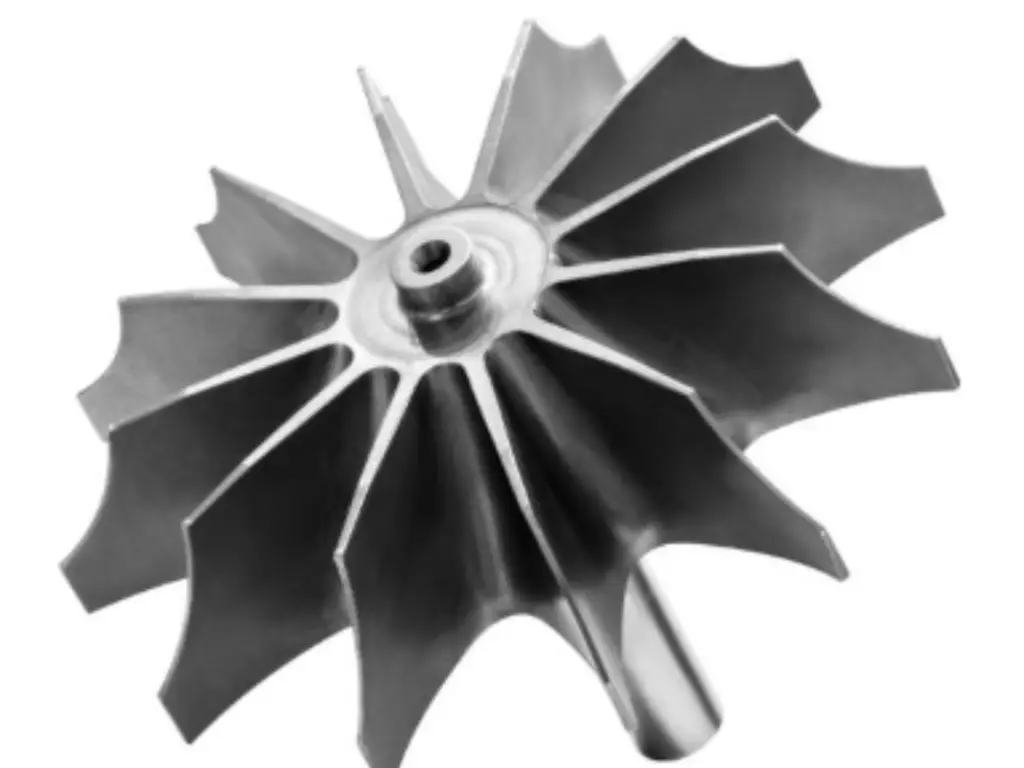
An open impeller consists of vanes attached to a central hub, with no front shroud covering the blade tips. Some designs also omit the rear shroud, leaving the blades nearly freestanding. This exposed construction creates a clearance gap between each vane tip and the pump casing, typically 0.3 to 0.8 mm depending on impeller diameter. That gap is the root of nearly every performance trade-off you will encounter.
Because the blades are not sealed, a portion of the fluid recirculates backward across the vane tips instead of moving forward into the discharge. This leakage reduces volumetric efficiency and caps the typical efficiency range at 50% to 70%. The upside is equally straightforward: with no enclosed channels to trap debris, solids, fibers, or sludge pass through freely. An open impeller can be inspected visually without disassembling the pump, a practical advantage that maintenance teams value highly.
A semi-open variant adds a rear shroud while leaving the front open, offering a middle ground at roughly 60% to 75% efficiency. The cantilevered blade structure of open designs, however, produces lower natural frequencies than enclosed alternatives. That makes vibration management worth an extra look during specification.
Closed Impeller Design and Internal Flow Paths
A closed impeller sandwiches the vanes between a front and rear shroud, creating sealed internal flow channels that guide fluid directionally from the eye to the discharge. Wear rings, replaceable clearance rings mounted on both shrouds, maintain the tight gap between the rotating impeller and the stationary casing. In a new pump, this gap is typically 0.2 to 0.5 mm.
Sealing the flow path eliminates the tip-leakage loss that handicaps open designs, pushing efficiency into the 70% to 90% range. A 2022 study published in Frontiers in Energy Research found that closed impellers produce the most uniform pressure distribution and the lowest pressure pulsation amplitude among common centrifugal designs. That is a meaningful advantage in applications where vibration translates directly into bearing wear and seal failures. The dual-shroud construction also gives the rotor system higher natural frequencies, making it easier to avoid resonance across the operating speed range.
The trade-off is equally clear. Solid particles that enter the sealed channels become trapped between the blade surfaces and shrouds. Once a wear ring clearance opens beyond approximately 0.8 to 1.0 mm, which happens gradually in abrasive service, the efficiency advantage erodes and the rings must be replaced. There is no field adjustment that restores it. API 610, now in its 11th edition, permits fully enclosed, semi-open, and open impeller designs. That reflects the reality that no single architecture wins every application.
Efficiency and Performance — By the Numbers
Numbers without context mislead. The efficiency gap between open and closed impellers is real, but it narrows or widens depending on specific speed, operating point, and maintenance state. The table below lays out the dimensions that matter.
| Dimension | Open Impeller | Closed Impeller | Notes |
|---|---|---|---|
| Efficiency Range | 50–70% | 70–90% | Semi-open: 60–75%; gap narrows at higher specific speeds |
| Head per Stage | Higher theoretical ceiling (~15,000–25,000 ft·lb/lb mass) | Lower ceiling due to shroud centrifugal stress | Open impellers lack the front-shroud stress limit |
| Tip Speed Capability | Up to ~130 ft/s, limited by material tensile strength | Up to ~130 ft/s, limited by erosion in dirty water | Maximum speed depends on material selection for both types |
| Pressure Pulsation | Higher amplitude, especially near volute tongue | Lowest amplitude, most uniform distribution | Frontiers in Energy Research, 2022 |
| Vibration Stability | Lower natural frequency, more modes to manage | Higher natural frequency, easier resonance avoidance | Dual-shroud constraint raises blade natural frequency |
| NPSH Requirement | Typically higher | Typically lower, wider safe operating range | Relevant to suction-condition-limited installations |
| Axial Thrust | Higher (unless pump-out vanes used) | Lower | Shrouds balance axial forces, extending bearing life |
One nuance that rarely appears in marketing comparison tables deserves attention. Practicing engineers on forums like Eng-Tips have long noted that a semi-open impeller can deliver roughly 2% higher peak efficiency than a closed design when brand-new, but that advantage is a “false efficiency.” The moment the impeller axial setting drifts or the vane tips begin to wear, efficiency falls below that of a properly maintained enclosed impeller. What you measure on the test stand and what you get after 4,000 operating hours are two different things.
Where Each Impeller Type Wins — Application Matrix
Choosing an impeller type without naming the fluid is like choosing tires without naming the road surface. The table below maps common applications to the impeller design that serves them best, with the reasoning behind each recommendation.
| Application | Fluid Type | Recommended Impeller | Why |
|---|---|---|---|
| Municipal Water Supply | Clean water | Closed | Maximum efficiency for continuous operation, no solids |
| Irrigation & Dewatering | Clean to slightly turbid water | Closed or Semi-open | Efficiency matters; semi-open if occasional debris expected |
| Boiler Feed Water | High-purity water | Closed | Sustained high efficiency, zero solids tolerance |
| Chemical Processing | Clean chemicals, solvents | Closed | Sealed flow path prevents contamination |
| Oil & Gas Transfer | Clean oils, refined products | Closed | Efficiency and leak-tightness priority |
| Wastewater & Sewage | Effluent with solids, fibers | Open or Semi-open | Solids pass-through; closed impellers clog rapidly |
| Mining Slurries & Tailings | Abrasive solid-liquid mixtures | Closed hard-metal or rubber-lined | The hard solids require wear-resistant materials, not an open design |
| Paper Stock & Pulp | Fibrous suspensions | Semi-open | Fibers wrap around closed shrouds; semi-open handles stringy material |
| Food Processing | Viscous fluids, soft solids | Open or Semi-open | Cleanability and solids tolerance |
| Pharmaceutical | High-purity liquids | Closed | No contamination risk, CIP-compatible |
| Construction Drainage | Dirty water with debris | Open | Debris tolerance over efficiency |
| Marine Ballast | Seawater with organisms | Open or Semi-open | Tolerance to entrained matter |
The ANSI chemical pump market has largely standardized on threaded, semi-open impellers. Models like the Goulds 3196 and Durco Mark III are ubiquitous in that space. Meanwhile, the water, irrigation, and building-services market remains solidly anchored to enclosed, keyed impeller designs. Neither camp is converging toward the other, and for good reason: the fluids and operating profiles are fundamentally different.
Maintenance, Wear, and the Real Cost Picture
Upfront cost tells less than half the story. The impeller type you choose sets the trajectory for every maintenance dollar you will spend over the pump’s service life.
Inspection and cleaning. Open impellers expose their internal surfaces to visual inspection without a teardown. A maintenance technician can assess vane condition through the casing opening in minutes. Closed impellers require disassembly to examine internal flow passages. If a clog has formed inside the shrouded channels, clearing it is a labor-intensive job.
Wear compensation. This is where open impellers hold a decisive operational edge. As vane tips and the casing wear over time, the rotating assembly can be adjusted axially to restore the original tip clearance. It is a 30-minute field procedure with zero parts cost. Closed impellers, by contrast, rely on wear rings. Once the clearance opens beyond the acceptable threshold, the rings must be replaced. Typical parts cost runs $200 to $800 for a medium-frame pump, plus 4 to 8 hours of shop labor.
Manufacturing cost. Open impellers are simpler to cast, with no internal cavities or soluble cores required. Closed impellers demand more complex tooling. The internal flow channels between shrouds often require multi-piece shell molds or dissolvable ceramic cores, pushing casting tooling cost to roughly 1.5 to 2 times that of an equivalent open design.
Lifecycle economics. In a clean-liquid, high-duty-cycle application like a boiler feed pump running 7,000 hours per year, the closed impeller’s efficiency advantage repays its higher initial cost within the first 18 to 24 months of operation through energy savings alone. In a dirty-water application where the pump is torn down quarterly for cleaning anyway, an open impeller’s repairability and adjustability win the total-cost-of-ownership argument. Neither type is cheaper in absolute terms. The math changes with the application.
Making the Right Choice — A Practical Decision Framework
After absorbing the details above, the selection decision boils down to three questions. Answer them honestly against your operating conditions, and the recommendation follows naturally.
| Scenario | Recommended Type | Trade-off to Accept |
|---|---|---|
| Clean water, continuous duty, >6,000 hrs/yr | Closed | Higher maintenance complexity |
| Wastewater with solids and fibers | Open or Semi-open | Lower efficiency |
| Chemical process, high purity required | Closed | Clog sensitivity (install strainer upstream) |
| Remote installation, limited maintenance access | Open | Efficiency penalty acceptable against uptime |
| Abrasive slurry (mining, dredging) | Closed hard-metal | Not an open impeller — choose material, not architecture |
The three-question sequence mimics a diagnostic approach rather than a look-up table, because pump selection is, at its core, a diagnosis of operating conditions. Answer in order, and the impeller type reveals itself.
From Selection to Sourcing — What to Ask Your Casting Supplier
Knowing which impeller type you need is one thing. Translating that need into a specification your casting supplier can execute is another. It is the step that most online guides leave entirely to chance. Understanding the basics of material selection and quality requirements before you send the RFQ will save you at least one round of back-and-forth.

Material Grades and Casting Processes per Impeller Type
The impeller type influences both your material choice and the casting process the foundry will use. The table below maps the typical combinations.
| Impeller Type | Typical Material Grades | Recommended Casting Process | Key Consideration |
|---|---|---|---|
| Open Impeller | SS304, SS316, carbon steel, bronze | Sand casting or investment casting | Simpler geometry allows lower-cost sand casting; investment casting preferred for tighter tolerances when the impeller is small |
| Closed Impeller | SS316, SS316L, duplex stainless (2205, 2507), nickel alloys (Hastelloy C-276) | Silica sol investment casting | Internal flow channels demand precision shell-building — silica sol achieves the required CT4–CT6 tolerances (ISO 8062) and Ra 3.2–6.3 µm surface finish inside the channels |
| Semi-Open Impeller | SS304, SS316, duplex, aluminum bronze | Investment casting or 5-axis CNC from billet | Rear-shroud geometry suits investment casting; low-volume runs may favor machining |
| High-Temperature | Inconel 625, Inconel 718, K418, IN657 | Vacuum investment casting | Nickel-based superalloys require vacuum melting to prevent oxidation and achieve thin-wall capability down to 0.5 mm |
| Corrosive (Chlorides) | Duplex 2205, super duplex 2507, Hastelloy C-276 | Silica sol or vacuum investment casting | Material upgrade path: SS316 → duplex → super duplex → Hastelloy as chloride concentration and temperature increase |
Closed impellers deserve extra scrutiny when writing a material specification. The internal flow passages between shrouds are inaccessible to visual inspection after casting. If a shrinkage cavity or gas porosity forms inside those channels, it will go undetected without the right NDT. Under cyclic loading during operation, that hidden defect can propagate into a crack that no amount of maintenance catches until the impeller fails. This is why the casting process matters as much as the material grade on the drawing.
Quality Assurance — Certifications and Inspection Methods That Matter
Specifying the right inspection methods per impeller type prevents the two most common sourcing mistakes: over-specifying tests that add cost without value, and under-specifying tests that leave critical defects undetected.
| Inspection Method | Open Impeller | Closed Impeller | What It Detects |
|---|---|---|---|
| Visual Inspection (VT) per ASTM E165 | Essential — all external surfaces accessible | Useful for exterior only — internals hidden | Surface cracks, casting flash, obvious porosity |
| Dye Penetrant (PT) | Essential — fast, low-cost surface check | Limited — cannot reach internal passages | Surface-breaking defects on accessible areas |
| X-Ray Radiography (RT) per ASTM E446 | Usually unnecessary | Essential — the only way to verify internal channel integrity | Internal shrinkage, gas porosity, and cracks inside shrouded flow paths |
| Ultrasonic Testing (UT) | Useful for thick sections | Important — wall thickness verification and subsurface flaw detection | Internal defects and wall-thickness conformance |
| CMM Dimensional Inspection | Essential — verify critical mounting dimensions | Essential — plus verify internal passage geometry where accessible | Dimensional conformance to drawing; tolerance to CT4–CT6 (ISO 8062) |
| Dynamic Balancing per ISO 1940 | Important for high-speed units | Critical — closed impellers operate at higher speeds with tighter vibration limits | Imbalance-induced vibration; target G6.3 for standard pumps, G2.5 for high-speed |
The X-ray radiography requirement for closed impellers is non-negotiable for critical service. A supplier who pushes back on RT for a closed impeller is essentially asking you to accept blind risk on the one part of the casting you cannot see. Look for foundries that hold IATF 16949 or ISO 9001 certification. These standards mandate process control that catches defects before the casting leaves the floor, not just at final inspection.

Finding a casting partner who understands both open and closed impeller manufacturing is not always straightforward. Many foundries handle open designs comfortably because the geometry is simpler and the tooling cost is lower. Closed impellers demand a higher level of shell-building precision, internal-channel surface finish control, and the NDT capability to verify what the eye cannot see. When evaluating suppliers, the combination that matters most is investment casting capability paired with in-house spectrometer analysis, CMM inspection, and X-ray radiography. Those three tools together close the quality loop on an impeller casting that will spend the next decade spinning at 3,500 rpm inside a pump housing. If you are currently sourcing open or closed impeller castings and want to discuss your project requirements with a team that handles both geometries, visit the BesserCast contact page. A brief conversation about your application and material needs is always free of charge.
The information in this article is based on publicly available engineering literature, industry standards, and community knowledge from practicing pump engineers. Specific material and process recommendations should be validated against your operating conditions and supplier capabilities.
References
- Gülich, Johann Friedrich. Centrifugal Pumps. 4th ed., Springer, 2020. springer.com.
- “Pressure Pulsation and Vibration Characteristics of Centrifugal Pumps with Different Impeller Types.” Frontiers in Energy Research, 2022. frontiersin.org.
- American Petroleum Institute. API Standard 610: Centrifugal Pumps for Petroleum, Petrochemical and Natural Gas Industries. 13th ed., 2026. api.org.
- ASTM International. “ASTM E446: Standard Reference Radiographs for Steel Castings Up to 2 in. (50.8 mm) in Thickness.” astm.org.
- International Organization for Standardization. ISO 8062-3:2023—Geometrical Product Specifications: Dimensional and Geometrical Tolerances for Moulded Parts, Part 3. iso.org.
- International Organization for Standardization. ISO 21940-11:2016—Mechanical Vibration: Rotor Balancing, Part 11—Procedures and Tolerances for Rotors with Rigid Behaviour. Including Amendment 1:2022. iso.org.


 English
  Japanese
  German
  Italian