
Manganese Steel vs Carbon Steel — Which One Belongs in Your Next Cast Part?
If you are sourcing a cast steel component, the choice between manganese steel and carbon steel shapes everything downstream. It affects how the part is poured, how it is finished, and how long it lasts in service. The two materials share iron and carbon in their chemistry, but the similarities end there.
This comparison walks through what separates them at the metallurgical level, how those differences play out in real-world applications, and what happens in the foundry before either material reaches your loading dock. Most comparison articles stop at property tables. This one goes further: the material you pick also determines how hard it is to cast it right.
Chemical Composition — What Sets Them Apart
Manganese steel is properly known as Hadfield steel, after the British metallurgist Sir Robert Hadfield who invented it in 1882. It is an austenitic alloy defined by one number: manganese content of 11–14%. That is roughly ten times the manganese level found in any carbon steel grade. Carbon steel, by contrast, is fundamentally iron plus carbon — anywhere from 0.2% to over 1.0% depending on the grade — with manganese playing only a supporting role at under 1.65%.
| Element | Manganese Steel (ASTM A128 Gr. B-2) | Carbon Steel (Typical) |
|---|---|---|
| Carbon (C) | 1.05–1.20% | 0.20–1.00% (grade-dependent) |
| Manganese (Mn) | 11.5–14.0% | 0.30–1.65% |
| Silicon (Si) | ≤1.00% | Trace amounts |
| Other | May include Cr, Mo, Ni per grade | Generally none beyond C, Mn, Si |
The manganese-to-carbon ratio must stay above 10:1 to maintain a fully austenitic microstructure. That crystal structure makes everything else possible. Drop below the threshold, and the material loses its defining properties. This single compositional difference — 12% Mn versus less than 2% — drives every performance and manufacturing contrast that follows.
Mechanical Properties Head-to-Head
Before diving into the numbers, a principle worth internalizing: carbon steel’s properties are fixed by heat treatment. What leaves the foundry is what you get in service. Manganese steel’s properties are shaped by the service itself. It becomes what the job demands. This difference governs every comparison below.
The Work-Hardening Mechanism — Why Manganese Steel Gets Tougher Under Impact
Manganese steel in its as-cast and heat-treated state is relatively soft, around 180–220 Brinell (BHN). That is unremarkable. What matters is what happens when it takes a hit.
Under impact or high-pressure contact, the austenitic microstructure at the surface undergoes a strain-induced transformation to martensite, a much harder phase. The surface hardness climbs to 500–550 BHN, rivaling the hardest heat-treated carbon steels. But only the outer 3–5 millimeters transform. The core stays tough and austenitic, capable of absorbing further impact without fracturing. This is where most misunderstandings happen.
The catch: no impact, no transformation. In a low-stress sliding-wear environment — fine sand, loose particles, gentle abrasion — manganese steel’s wear resistance is no better than mild carbon steel. The magic only activates when the blows are heavy enough to deform the surface.
Hardness, Strength, and Toughness — The Numbers That Matter
| Property | Manganese Steel (Hadfield) | Carbon Steel (High-C, Heat-Treated) |
|---|---|---|
| Surface Hardness (in service) | 500–550 BHN | 200–500 BHN (grade and temper dependent) |
| Toughness (Charpy V-notch) | ≥140 J/cm² at 20°C | 20–80 J (falls sharply with carbon content) |
| Tensile Strength | 880–965 MPa | 400–1,200+ MPa (wide range) |
| Yield Strength | 345–415 MPa | 250–800+ MPa |
| Elongation | 40–50% | 10–25% (high-carbon grades) |
The table reveals a pattern that surprises many engineers: manganese steel does not win on every number. Its yield strength is modest. If the part faces high static loads without impact, a heat-treated medium-carbon steel holds its shape better.
What manganese steel uniquely delivers is the combination: extreme surface hardness plus deep core toughness plus huge elongation before fracture. A carbon steel hardened to 500 BHN becomes brittle, like glass. A manganese steel at 500 BHN surface hardness can still stretch 40% before breaking. That combination does not exist in carbon steel at any grade.
Opposite Heat Treatment Responses
Here is a fact that catches even experienced engineers off guard: rapid cooling makes carbon steel hard and manganese steel soft.
Manganese steel must be solution-annealed at 1,000–1,100°C and then water-quenched rapidly. The quench locks in the austenitic structure, the soft, tough, work-hardenable state you want. If it cools slowly instead, or if it is reheated above roughly 275°C during service or welding, carbides precipitate along the grain boundaries and the material turns brittle. This is the opposite of carbon steel: quenching produces hard martensite in carbon steel, while slow cooling produces softer pearlite. A shop that heat-treats both materials needs two separate process routes.
Casting and Manufacturing — What Happens Before the Part Reaches You
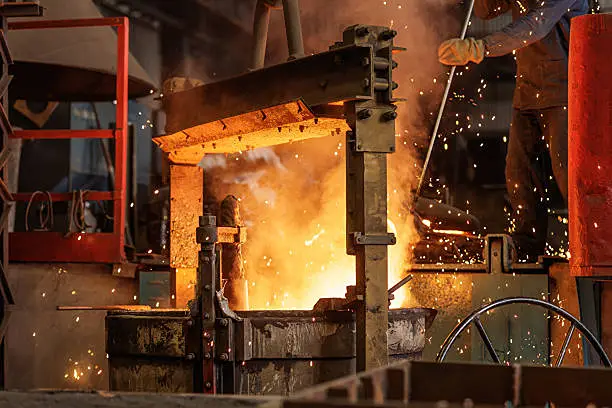
The material you specify does not just determine how the part performs. It determines how hard it is to make, and whether your supplier can make it at all. This is the chapter most comparison articles skip. It is also the one that separates a smooth procurement from a production disaster.
Castability and Common Defects — Why Manganese Steel Castings Are Harder to Get Right
Carbon steel casting is a mature, well-understood process. Common defects like shrinkage porosity and gas holes are predictable and controllable with standard gating and riser design. Most foundries that pour steel can pour carbon steel.
Manganese steel raises the bar in three specific ways:
Element segregation. With 12% manganese in the melt, the alloying elements do not distribute evenly during solidification. Manganese concentrates in the last metal to freeze, creating composition bands that can compromise mechanical uniformity. This demands tighter control over pouring temperature and cooling rate than carbon steel requires.
Hot tearing. Manganese steel has roughly one-quarter the thermal conductivity of carbon steel, about 13–15 W/(m·K) versus approximately 50 W/(m·K). Heat does not flow away from the solidifying casting as quickly, so thermal stresses build up at section transitions. The gating and riser design that works fine for a carbon steel part of the same geometry may produce hot cracks in manganese steel.
The quench window. After casting, the part must be reheated to 1,000–1,100°C and water-quenched. The time from furnace exit to full immersion is measured in seconds, typically under 90. Any delay allows the surface temperature to drop into the carbide-precipitation range. Miss the window, and the entire batch may need to be scrapped. This is not a consideration for carbon steel, where post-casting heat treatment is more forgiving.
What this means in practice: a foundry that reliably produces manganese steel castings operates with a level of process discipline that carbon-steel-only shops never need to develop. Certifications like IATF16949, originally designed for the automotive supply chain, capture exactly this kind of process control capability.
Post-Casting Processing — Machining, Welding, and What You Need to Know
| Process | Carbon Steel | Manganese Steel |
|---|---|---|
| Machining | Standard tooling, predictable | Extremely difficult. Work-hardens instantly under cutting tools; carbide tooling or grinding required |
| Welding | Generally good (low-carbon grades) | Requires nickel-based electrodes; preheat must not exceed 260°C; never weld directly to carbon steel |
| Surface Treatment | Standard plating, coating, painting | Requires preparation adapted to austenitic surface; standard pretreatments may not adhere |
The machining difficulty deserves emphasis: manganese steel cannot be meaningfully softened by annealing. The moment a cutting tool touches the surface, the material work-hardens in response, exactly as it does in service. The only practical approach is to minimize post-casting machining by starting with a near-net-shape casting. Investment casting (lost wax) routinely achieves ISO 8062 tolerance grades CT4–CT6. It is one of the few processes that can deliver manganese steel parts requiring little to no machining, avoiding the problem at the design stage rather than fighting it on the shop floor.
Where Each Material Belongs — An Application Guide
Material selection is not about which steel is “better.” It is about which steel matches the forces your component will actually face. The wrong material in the right application fails just as surely as the reverse.
High-Impact, High-Abrasion — Where Manganese Steel Is the Only Choice
When the service environment combines repeated heavy impact with abrasive wear, manganese steel has no peer at its price point:
- Mining and crushing equipment. Crusher jaws, cone mantles, hammer mill grates, and grinding mill liners are the classic applications. The rock itself provides the impact that keeps the surface hardened. A heat-treated carbon steel jaw at the same initial hardness would crack under the first few thousand blows. The manganese steel jaw actually gets harder with use.
- Railway frogs and crossings. Where rails intersect, wheels deliver a hammer blow with every passing train. Manganese steel crossings absorb the impact, surface-harden in response, and typically outlast carbon steel by a factor of three to five.
- Excavator and dredge components. Bucket teeth, lip shrouds, and cutter heads face both impact from digging and abrasion from the material being moved. Manganese steel’s combination of surface hardness and core toughness is the only reason these parts survive.
- Military armor plate. The ability to absorb projectile energy without shattering, even as the impact point hardens, makes Hadfield steel a long-standing armor material.
Moderate Conditions — Where Carbon Steel Delivers Better Value
Carbon steel is not the second-choice material. In applications without significant impact, it is the first choice:
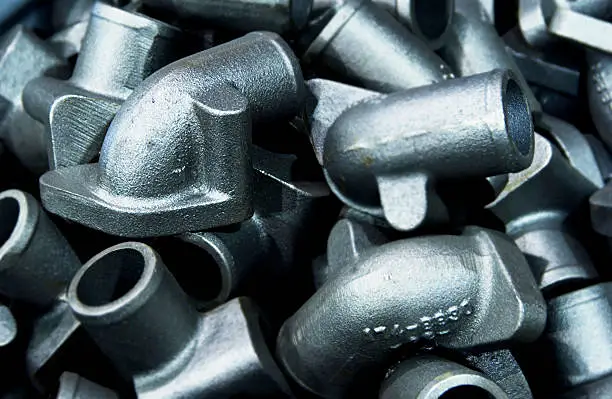
- Pump bodies, valve housings, and pipe fittings. These components face fluid pressure and mild flow-induced wear, not impact. A properly heat-treated carbon steel casting meets all mechanical requirements at roughly one-third to one-half the material and processing cost of manganese steel. There is no work-hardening benefit to pay for.
- General structural components. Brackets, frames, bases, and housings need strength and rigidity, not wear resistance. Carbon steel is weldable, machinable, and available. Three things manganese steel is not.
- Automotive and agricultural parts produced in high volume. When thousands of identical parts need stable machining characteristics and predictable per-unit cost, carbon steel is the default. Manganese steel’s fabrication difficulties become a liability at scale.
An important caveat: If the wear mechanism is low-stress sliding abrasion — fine sand, powder flow, non-impact particle contact — standard manganese steel actually underperforms heat-treated carbon steel. Without impact to trigger work-hardening, the manganese steel surface stays at its as-cast ~200 BHN softness while a hardened carbon steel surface holds at 400+ BHN from the start. In these conditions, alternatives like high-chromium white iron or carbide-overlay carbon steel should also be on the table.
The Gray Zone — When Either Could Work
Not every application lands clearly on one side. Three questions can help break the tie:
- Does the part take repeated impact? Yes → lean manganese steel. No → lean carbon steel.
- Does the part need significant post-casting machining? Yes → lean carbon steel, or investigate near-net-shape investment casting to eliminate the machining requirement.
- What does a failure cost? If unplanned downtime costs thousands per hour, manganese steel’s longer service life can justify its higher upfront cost even in borderline applications. The math shifts when the replacement cost includes lost production.
A practical example from the pump and valve sector: a standard pump housing runs fine in carbon steel. But the internal wear plates or impeller of a slurry pump handling abrasive ore slurry at high velocity may benefit from manganese steel. The solid particles deliver impact, not just sliding contact. The distinction is impact, not industry.
Cost vs. Lifetime Value — The Real Economics
Manganese steel castings cost more. The raw numbers: a manganese steel part typically runs two to three times the unit price of an equivalent carbon steel part. The premium comes from three sources. Higher alloy cost — manganese, plus chromium or molybdenum in some grades. More energy-intensive heat treatment — 1,000–1,100°C solution annealing versus conventional quench-and-temper. And a higher scrap rate from the tighter process control requirements discussed above.
The unit price, however, tells only half the story.
In an impact-abrasion application like a crusher liner, the manganese steel part may last three to five times longer than a hardened carbon steel replacement. Factor in the labor to swap the part, the production lost during each change-out, and the risk of collateral damage from a sudden failure. The total cost of ownership often favors manganese steel even though the invoice price is higher. In mining operations, where a single hour of crusher downtime can cost tens of thousands of dollars in lost throughput, the TCO argument for manganese steel is overwhelming.
The reverse is equally true: putting manganese steel into a low-impact, general-engineering application is simply overpaying. You are buying work-hardening capacity the part will never use. Carbon steel, properly specified and heat-treated, is the economically rational choice for the majority of industrial cast components.
How to Evaluate a Casting Supplier for Either Material
Choosing the material is step one. Finding a supplier who can execute the choice reliably is step two. It determines whether your specification actually translates into parts that work.
Five criteria to assess before placing an order:
1. Material range and experience. Does the supplier pour both carbon steel and manganese steel regularly, or is one an occasional side line? A foundry that casts carbon steel daily but manganese steel once a quarter is unlikely to have the process dialed in for the latter. Ask for a material grade list and the volume split.
2. Quality management system. For manganese steel in particular, the difference between a good casting and scrap can be seconds in the quench window and degrees in the pour temperature. A quality system with real process control — IATF16949, not just ISO 9001 on paper — indicates the kind of disciplined operation that manganese steel demands.
3. In-house testing capability. At minimum, the supplier should operate an optical emission spectrometer for chemistry verification per heat and per batch, a coordinate measuring machine for dimensional inspection, and hardness and tensile testing equipment. For critical manganese steel parts, ask about internal defect inspection: ultrasonic or X-ray.
4. Post-casting integration. Manganese steel is difficult to machine. A supplier who offers both casting and CNC machining under one roof can design the casting to minimize machining stock from the start. That saves you from solving the machining problem on your own. The same logic applies to surface finishing: one responsible party is better than three.
5. Track record in your industry. A casting supplier who has delivered similar parts to similar end-users already understands the unspoken requirements. Surface finish expectations. Documentation packages. Inspection protocols. A generalist would need to learn these on your order.
Established casting manufacturers who meet these criteria offer a measurable difference in quality assurance compared to shops operating on experience alone. Look for facilities holding IATF16949, ISO 9001, ISO 14001, and ISO 45001 certifications simultaneously, with in-house spectrometer and CMM capability. Besser Casting, with four-system certification and both carbon steel and manganese steel on its 200+ material grade list, is one reference point for what a full-capability investment casting supplier looks like in practice (Besser Casting; certifications at bessercast.com/quality).
Not every project needs a supplier who checks all five boxes. But knowing what to ask for puts you in control of the trade-offs.
References
- Total Materia. “High Manganese Austenitic Steels: Part One — Chemical Composition and Mechanical Properties.” totalmateria.com
- Clifton Steel. “Manganese Steel Plate — Hadfield Grade TENSAMANG.” cliftonsteel.com
- CFS Foundry. “Investment Casting Tolerances — ISO 8062 CT4–CT6.” investmentcastchina.com
- Manganese Supply. “Manganese Steel vs Carbon Steel: Strength, Uses & Cost Comparison.” manganesesupply.com
- Besser Casting. “Investment Casting Tolerance Standard.” bessercasting.com
- Besser Casting. “Quality Certifications.” bessercast.com/quality/
- Besser Casting. Homepage. bessercast.com
- Besser Casting. Contact. bessercast.com/contact/
 English
  Japanese
  German
  Italian