
Cast Iron vs Cast Steel: How to Choose the Right Material for Your Cast Parts
Where the Line Is Drawn — Carbon and the Two Metal Families
The difference between cast iron and cast steel comes down to a single number: 2% carbon. Below this threshold, you’re in steel territory. Carbon dissolves into the iron matrix, producing a tough, ductile material. Above it, the carbon can no longer stay dissolved. It precipitates out as graphite, and the metal’s behavior shifts from “steel mode” to “cast iron mode.”
This isn’t an arbitrary cutoff. It comes from the iron-carbon phase diagram: at 1,148°C, austenite (the high-temperature phase of iron) can hold a maximum of 2.11 wt% carbon in solid solution (ASM International, 2019). Any carbon beyond that point forms a separate graphite or carbide phase during solidification. And that graphite is what gives cast iron its signature properties: excellent vibration damping, natural lubricity in sliding contact, and a brittleness that steel simply doesn’t share.
Think of it like sugar dissolving in water. Stir a teaspoon into hot water and it disappears — that’s carbon in steel. Keep adding sugar past the saturation point, and crystals settle at the bottom. In cast iron, those “crystals” are graphite flakes or nodules, and they fundamentally change how the metal responds to stress, heat, and time.
The Cast Iron and Cast Steel Family Tree
If you take away one thing from this article, let it be this: “cast iron” and “cast steel” are not two materials — they are two families of materials. The differences within each family can be larger than the differences between them.
Ductile iron, for example, belongs to the cast iron family but can reach tensile strengths above 600 MPa with elongation up to 18%. That performance overlaps with medium-carbon cast steel. Gray iron, its cousin in the same family, fractures at less than 1% elongation. Treating all cast iron as “brittle” and all cast steel as “tough” is a simplification that leads to bad decisions.
The table below gives each sub-type its own identity. Don’t memorize it. Use it as a reference to understand the range of options hiding behind the “iron vs. steel” shorthand.
| Material Type | Carbon % | Key Identifier | Tensile (MPa) | Elongation % | Typical Castings | Relative Cost |
|---|---|---|---|---|---|---|
| Gray Cast Iron | 2.5–4.0 | Flake graphite; best damping | 150–400 | <1 | Engine blocks, machine beds, pump housings | ★ |
| Ductile (Nodular) Iron | 3.0–3.8 | Spheroidal graphite; tough | 400–600 | 2–18 | Crankshafts, valve bodies, pipe fittings, gears | ★★ |
| White Cast Iron | 2.0–3.5 | Carbide structure; extremely hard | 200–400 | 0 | Mill liners, slurry pump parts, wear plates | ★½ |
| Malleable Iron | 2.0–2.8 | Heat-treated white iron | 300–500 | 2–12 | Pipe fittings, hand tools, railroad hardware | ★★ |
| Low-Carbon Steel | <0.30 | Ductile, weldable | 400–550 | 20–30 | Structural frames, housings, brackets | ★★★ |
| Medium-Carbon Steel | 0.30–0.50 | Balanced strength + toughness | 550–700 | 15–25 | Gears, railway wheels, crankshafts | ★★★ |
| High-Carbon Steel | 0.50–2.0 | High strength, low ductility | 650–900+ | 5–15 | Wear parts, tool bodies, crusher components | ★★★½ |
| Alloy / Stainless Steel | varies + Cr/Ni/Mo | Tailored for corrosion/heat/wear | 500–1,000+ | 10–40 | Chemical pumps, marine hardware, turbine housings | ★★★★★ |
Cost comparison is relative — same weight, same complexity. Actual part cost also depends on order quantity, tolerance requirements, and post-cast processing.
Head-to-Head — How Cast Iron and Cast Steel Actually Compare
Before diving into individual properties, it helps to organize what you’re comparing into three layers. Mechanical properties tell you whether the part survives its first day in service: strength, hardness, toughness. Physical and service properties tell you how long it lasts and how it behaves in its working environment: wear, damping, corrosion, temperature resistance. Manufacturability and economics tell you whether the part can be made at a cost your project can absorb: castability, machinability, weldability, and unit price. All three layers matter. Engineers who stop at mechanical properties routinely end up with designs that are technically sound but commercially unviable.
Mechanical Properties — Strength, Hardness, and the Brittleness Trade-Off
The question every engineer asks first: “Which one is stronger?” The answer depends entirely on what kind of strength you mean.
In tension, cast steel dominates. A typical medium-carbon cast steel (ASTM A216 Grade WCB) delivers 485–655 MPa tensile strength (ASTM International). Gray cast iron (ASTM A48 Class 30) manages around 207 MPa. That’s a 2–3× gap. But in compression, the story flips. Gray iron’s compressive strength can reach 3–4 times its tensile strength, roughly 600–800 MPa for a Class 30 iron, because the graphite flakes that act as stress concentrators in tension are largely harmless under pure compression. Cast steel’s compressive strength, meanwhile, tracks roughly 1:1 with its tensile strength.
The practical consequence: a machine tool bed, loaded almost entirely in compression, has no reason to pay the premium for cast steel. A suspension component that sees cyclic tension, bending, and occasional impact has every reason to avoid gray iron. A brittle fracture in service is not a failure mode you negotiate with.
Ductile iron sits between the two, and it’s the reason you should never make this decision without checking whether nodular iron can do the job. ASTM A536 Grade 60-40-18 delivers 414 MPa tensile with 18% elongation. Those numbers put it squarely in competition with low-carbon cast steel, at roughly two-thirds the material cost.
Think of the difference like this: gray iron is a cracker. Strong if you press straight down, but snap it sideways and it breaks clean. Cast steel is a piece of hard rubber — you can pull it, bend it, and it deforms before it fails. Ductile iron is the cracker with fiber reinforcement. It still breaks, but not easily.
Physical & Service Properties — Wear, Damping, Corrosion, and Temperature
Once a part leaves the design spreadsheet and enters the real world, the properties that determine its service life are rarely the ones that drove the initial material selection.
Wear resistance is gray iron’s hidden advantage. The graphite flakes embedded in its microstructure act as a solid lubricant: they shear easily, smear across sliding surfaces, and maintain a stable friction coefficient between 0.3 and 0.4 across a wide temperature range. That’s why brake discs and drums are almost universally gray iron. It’s also why machinists prefer cast iron machine tables: the graphite in the part lubricates the tool as it cuts.
Vibration damping is where gray iron leaves every other ferrous casting material in the dust. Measured by specific damping capacity, gray iron dissipates 20–500 × 10⁻⁴ units of vibration energy per cycle, compared to just 1–4 units for cast carbon steel (Atlas Foundry). That’s a 10–100× advantage. It’s why precision machine tool beds, engine blocks, and measurement equipment bases are essentially irreplaceable by steel. The graphite flakes create localized micro-plasticity zones that convert mechanical vibration into heat — a damping mechanism steel cannot replicate.
Corrosion resistance is more nuanced than most comparison tables suggest. Both gray cast iron and plain carbon steel rust when exposed to moisture. Cast iron holds a slight edge in atmospheric exposure because it forms a tighter, more adherent oxide scale. But in any chemically aggressive environment, neither is adequate. Stainless steel castings (CF8, CF8M) or alloy steels with ≥11% chromium are the answer when corrosion is a design requirement, and those are solidly in the cast steel camp.
Temperature limits create a hard boundary. Carbon steel castings (ASTM A216 WCB) are rated for continuous service up to approximately 540°C. Gray iron starts to degrade above 400°C as the pearlite matrix decomposes, causing irreversible volumetric growth. For high-temperature valves, pumps, and turbine components, cast steel alloys (WC6, WC9, or stainless) are the only option.
Here’s a way to think about damping: ring a steel bell and it sings for seconds. Strike a cast iron anvil with the same hammer and the sound dies instantly. That “deadness” is precisely what you want in a machine tool base. Every vibration absorbed by the casting is a vibration that doesn’t show up as a machining error on your workpiece.
Manufacturability & Economics — Castability, Machinability, Weldability, and Cost
Material cost per kilogram is the most visible number on a quote. It’s also often the least useful one for making a real comparison.
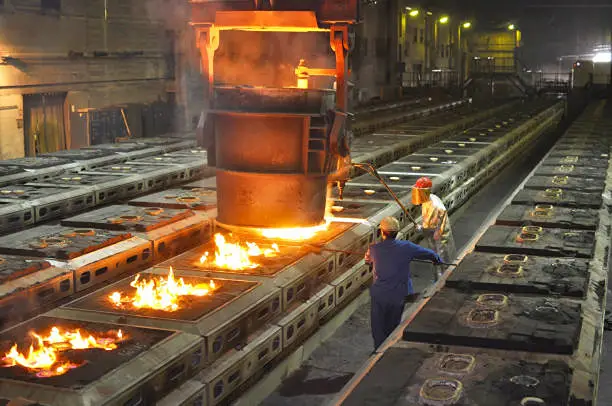
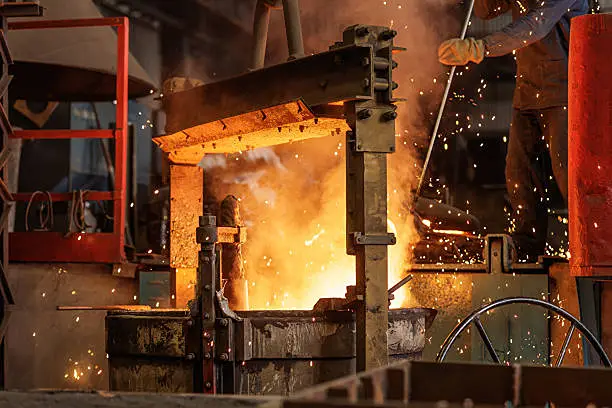
Castability favors cast iron decisively. Gray iron melts at 1,150–1,250°C. That’s 200–350°C lower than the 1,540–1,620°C pouring temperature of cast steel, which means lower energy costs, less furnace wear, and longer mold life. More importantly, cast iron’s higher fluidity at pouring temperature allows it to fill thin sections and complex geometries that cast steel struggles with. Gray iron’s linear shrinkage during solidification is approximately 1%, compared to roughly 2.5% for cast steel. Steel castings need larger risers, more gating design, and they carry higher scrap rates from shrinkage defects.
Machinability also goes to cast iron, and the reason is the same graphite that makes it brittle. Graphite flakes act as chip breakers and built-in lubricant during cutting, reducing tool wear and allowing higher cutting speeds. Machining a cast steel part of the same geometry can cost 30–50% more in tooling and cycle time.
Weldability is cast steel’s decisive win. Cast steel’s lower carbon equivalent means it welds readily with standard procedures. Cast iron welding is possible but remains a high-skill operation. It requires preheating to 260–650°C (depending on carbon equivalent and wall thickness), nickel-based filler rods, and controlled slow cooling. Even then, the heat-affected zone is prone to cracking. If your design requires field welding for installation or repair, cast iron is essentially off the table.
Cost: the full picture. Gray iron raw material is typically 20–30% cheaper per kilogram than carbon steel. The processing cost advantage (easier melting, faster machining, less gating) widens the gap further. But a lower unit cost does not automatically mean a lower total cost. A cast steel part that eliminates a machining step, survives 5× longer in service, or avoids a catastrophic field failure can have a far lower lifetime cost than a cheaper iron alternative. The material decision belongs in the same conversation as the manufacturing and quality plan, not in a separate procurement spreadsheet.
Think of it like this: buying cast iron instead of cast steel because the per-kilo price is lower is like choosing a building material because the bricks are cheaper. It ignores the labor to lay them, the time to build, and how long the wall will stand.
Why the Casting Process Matters for Your Material Choice
Most “cast iron vs. cast steel” articles stop at chemistry and mechanical properties. But foundry engineers know something that comparison tables miss: the same material grade, poured through different casting processes, produces parts with meaningfully different properties.
Cooling rate is the invisible hand. A gray iron poured into a sand mold cools at roughly 1°C per second, producing coarse graphite flakes in a ferritic matrix: soft, highly damped, and relatively weak. The same iron chemistry poured into a metal mold that cools at 10°C per second produces fine graphite flakes in a pearlitic matrix: 30–50 Brinell points harder and considerably stronger (Campbell, Complete Casting Handbook, 2nd ed., 2015). Same material on the certificate. Different part in service.
Surface finish and dimensional precision follow the same logic. Sand castings typically deliver Ra 12.5–25 μm surface roughness. Investment casting (lost wax / silica sol) achieves Ra 1.6–6.3 μm. That difference can eliminate an entire machining operation on functional surfaces. For parts where the as-cast surface is customer-visible or mates directly with another component, the casting process is not a secondary consideration. It is part of the material selection.
The practical takeaway: when you specify “gray iron” or “carbon steel” on a drawing, you are only telling half the story. The foundry’s process capability — shell molding, investment casting, vacuum casting, heat treatment capability — determines whether the material you selected will actually deliver the properties you designed for.
Where Each Material Wins — An Application-by-Application Guide
If you want to know whether cast iron or cast steel is right for your part, the quickest way is to look at where each material dominates in the real world. The question is never “which material is better?” It’s “better for what?” Here’s how the answer changes across three major application clusters.
Pump, Valve & Fluid Handling Equipment
Pump and valve castings are where the iron-vs-steel decision gets made every day, and there is no one-size-fits-all answer. Even within a single pump, different components may use different materials.
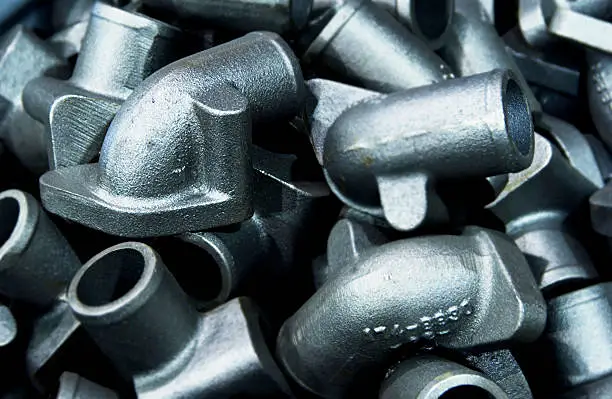
For low-to-medium-pressure water and general industrial pumps (typically ≤PN16–PN25), gray cast iron remains the workhorse. It pours easily into complex volute and impeller geometries, machines cleanly, and the graphite in its matrix provides natural lubrication for sliding wear surfaces like wear rings. Cost is hard to beat.
As pressure climbs, the decision shifts. Ductile iron valves can handle PN40 in many configurations, but above PN100, cast steel (ASTM A216 WCB) becomes the default. Not because iron can’t take the pressure, but because steel’s toughness provides a margin against brittle failure that codes and insurance requirements demand.
For chemical, high-temperature, and corrosive service, cast iron is largely out. Stainless steel (CF8M / 316, CF3M / 316L) or alloy steels (WC6, WC9 for creep-resistant high-temperature service) own this territory. Temperature is the hard filter: gray iron is generally limited to 200°C, ductile iron to 350–450°C (depending on grade), while cast Cr-Mo steels operate continuously at 540°C and above.
Automotive, Railway & Heavy Equipment
This sector has driven more innovation in cast materials than any other, because it combines two ruthless constraints: safety-critical performance and high-volume cost pressure.
Engine blocks and cylinder heads remain gray iron’s kingdom. Not because engineers haven’t tried aluminum or compacted graphite iron (CGI), but because gray iron’s combination of vibration damping, thermal stability, and casting complexity at a sub-$2/kg processed cost is extraordinarily difficult to displace. Brake discs and drums are gray iron for a different reason. The graphite that makes the material brittle also stabilizes the friction coefficient across a 100–500°C operating range — a self-regulating behavior no steel brake rotor matches without expensive surface treatments.
Where loads shift from compressive to dynamic, gray iron exits. Steering knuckles, suspension arms, and hitch components carry bending, tension, and impact. Here, ductile iron (EN-GJS-500-7 or ASTM A536 60-40-18) has steadily gained ground against cast steel. It delivers 500 MPa tensile with ≥7% elongation at a lower per-part cost, and modern inoculation practices have made its production reliable enough for automotive safety applications. Cast steel (ASTM A148 Grade 80/50) still holds the upper end where elongation above 15% is a hard requirement. Railway couplers and heavy truck chassis brackets are the classic examples.
Structural, Construction & General Industrial Applications
For applications where the part sits still, carries weight, and never sees an impact load, cast iron is almost always the answer. And it’s not close.
Machine tool beds and bases are the canonical case. A lathe bed under a 2-ton workpiece experiences near-pure compression with a side order of cutting vibration. Gray iron absorbs the vibration (10–100× better than steel), takes the weight (compressive strength 600–800 MPa), and does it in a casting that can be stress-relieved and precision-ground to micron-level flatness. Steel offers nothing here that iron doesn’t do better and cheaper.
Pipe and fittings have largely transitioned from gray to ductile iron (ISO 2531 / EN 545), driven by the need for some ductility under ground settlement and seismic displacement. Manhole covers, drainage grates, and bollards remain gray iron because the loading is pure compression and the cost difference is decisive at municipal procurement volumes.
The rule of thumb is simple: if your part stands still, gets pushed on from above, and never needs to be welded, gray iron is probably the right answer. The moment it moves, vibrates in a way you don’t want, or gets hit from the side, you need to move up the family tree toward ductile iron or cast steel.
Making the Right Call — A Decision Framework for Your Next Project
You now have the data. The question is how to use it. Material selection is not a purely technical decision. It sits at the intersection of engineering requirements, manufacturing realities, and supply chain risk. The next three sections walk you through each dimension, in the order you should think about them.
Start with the Load — What Is Your Part Actually Fighting?
Before you compare tensile strengths or cost-per-kilo, answer three questions about what your part actually experiences in service:
1. Is the dominant load compressive or tensile? If your part is primarily squeezed — a machine base, a valve body under internal pressure, a manhole cover — cast iron is in play. If it’s pulled, bent, or twisted — a lifting lug, a suspension arm, a bolted flange with high preload — you need steel or ductile iron. Gray iron under tension is a bet you don’t want to take.
2. Does the part see impact or shock loading? If the answer is yes — even occasionally — eliminate gray iron. The threshold is practical, not academic. If any service condition pushes stress above 50% of yield with a loading rate faster than 0.1 per second, gray iron’s lack of ductility makes brittle fracture a real risk. Ductile iron or cast steel is the floor.
3. Is vibration a problem to be eliminated — or a signal to be absorbed? If you’re building a rigid assembly where vibration is noise (most structural frames), steel’s higher stiffness serves you. If you’re building a machine that generates vibration as part of its function (every machine tool ever made), gray iron’s damping converts that vibration into heat instead of into your workpiece tolerance.
These three questions won’t give you a final answer, but they will eliminate the wrong one. That’s half the battle.
Factor in Manufacturing — What Happens After the Metal Pours
A material that works perfectly on a data sheet can fail commercially because it can’t be cast, machined, or finished at a viable cost. Run through these four checks before locking your selection:
Castability: Does your part have thin walls (below 4 mm), sharp geometry changes, or deep pockets? Gray iron handles these far more forgivingly than cast steel, which needs higher superheat and more elaborate gating. If your casting has a history of high scrap rates at the foundry, switching from steel to ductile iron can be a yield-improvement move, not just a cost move.
Machining budget: A steel casting of the same geometry typically costs 30–50% more to machine than its gray iron equivalent. The difference compounds with batch size. On a 1,000-part run, machining cost can eclipse material cost.
Weldability: If the part needs to be welded to anything — for assembly, for repair, for field modification — cast iron requires preheat, nickel-based filler, and post-weld slow cooling. It’s not impossible, but it is expensive and skill-dependent. Cast steel welds like any other carbon steel. If welding is in the production plan, cast iron is effectively out.
Heat treatment: Cast steel’s properties can be tuned across a wide range with quench-and-temper cycles. Gray iron’s heat treatment options are limited to stress relief and surface hardening. You cannot fundamentally change its strength-ductility profile after casting. If you need to dial in specific hardness-toughness combinations, steel gives you knobs to turn that iron simply doesn’t have.
Think of it like renovating a house: the material cost of the floor tiles is only one line on the invoice. The labor to install them, the time to let the mortar cure, and whether the subfloor underneath is even compatible — that’s where the real budget lives. Castings work the same way.
Verify Before You Commit — What to Ask Your Foundry
You can specify the perfect material on a drawing and still get a bad result if your foundry can’t execute. The good news: you don’t need to be a metallurgist to separate capable suppliers from the rest. Ask these four questions and watch how they answer.
“How do you verify melt chemistry before pouring?” A foundry that runs every heat through an optical emission spectrometer (OES) — and adjusts the composition before tapping, not after — is doing precision metallurgy. A foundry that relies on “experience” to judge carbon by the spark pattern is gambling. The difference shows up as heat-to-heat property variation that your machining department will discover long before the foundry hears about it.
“What’s the hardness spread across a single batch?” In a well-controlled foundry, castings from the same heat should fall within ±15 Brinell of each other. A spread of 30 HB or more signals inconsistent cooling, variable inoculation, or both. Inconsistent castings produce inconsistent machined parts.
“Can you produce both cast iron and cast steel parts?” This question reveals more than you might think. A foundry that runs both material families under the same roof, with dedicated process routes for each, has no incentive to steer you toward one material over another because of equipment limitations. A foundry that only pours gray iron will naturally recommend gray iron, whether or not it’s the best answer for your part.
“Are your tensile test bars separately cast or attached to the casting?” Separately cast test bars are the industry default — cheaper, easier, and adequate for most applications. But attached (cast-on) test bars, which cool at the same rate as the casting itself, tell you what your part’s actual properties are. Not what a separately poured coupon achieved under idealized conditions. If your application is safety-critical, this distinction matters. The best foundries offer both and are transparent about the difference.
These four questions function as a quick capability audit. If a foundry answers them clearly and backs up the answers with batch-level data, you’re dealing with a professional operation. If they deflect, generalize, or can’t produce the numbers, keep looking.
References
- ASM International. “Iron-Carbon Phase Diagram.” ASM Handbook, Volume 3: Alloy Phase Diagrams. 2019. https://www.asminternational.org/
- ASTM International. “ASTM A216/A216M-21: Standard Specification for Steel Castings, Carbon, Suitable for Fusion Welding, for High-Temperature Service.” https://www.astm.org/a0216_a0216m-21.html
- Atlas Foundry. “Mechanical Properties of Gray Iron — Damping Capacity.” http://atlas-foundry.com/grayiron-damping.htm
- Campbell, John. Complete Casting Handbook. 2nd ed. Elsevier, 2015. https://www.elsevier.com/books/complete-casting-handbook/campbell/978-0-444-63509-9
- Reliance Foundry. “Cast Iron vs Cast Steel.” https://www.reliance-foundry.com/blog/cast-iron-vs-cast-steel
- CFS Foundry. “Cast Steel vs. Cast Iron.” https://www.investmentcastchina.com/cast-steel-vs-cast-iron/
- BesserCast. “Quality Certifications.” https://www.bessercast.com/quality/
- BesserCast. “Contact.” https://www.bessercast.com/contact/
- BesserCast. Homepage. https://www.bessercast.com/
 English
  Japanese
  German
  Italian