
Investment Casting vs. Sand Casting: How to Choose the Right Process for Your Part
If you are sourcing metal components, the choice between investment casting and sand casting ripples through every aspect of your project. Tooling budget, unit cost, surface quality, dimensional accuracy, lead time — the process you pick shapes them all. And the decision is rarely as simple as “investment casting costs more.” For many parts, the process with the higher casting price delivers the cheaper finished component.
This guide compares the two processes across every dimension that matters. Then it gives you a systematic framework for choosing the right one and finding the right supplier once you do.
What Is Investment Casting?
Investment casting, also called lost-wax casting, is a precision manufacturing process that dates back thousands of years and now powers modern aerospace, medical, and industrial supply chains.
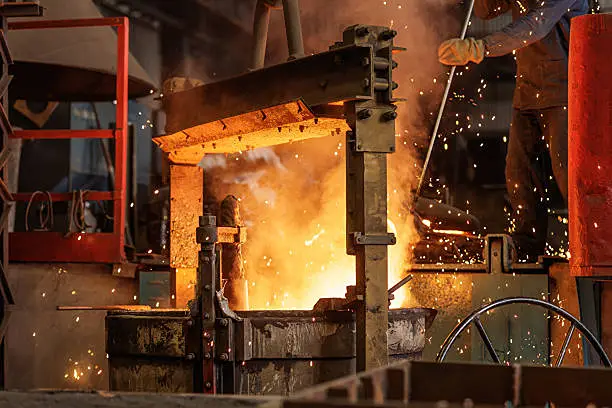
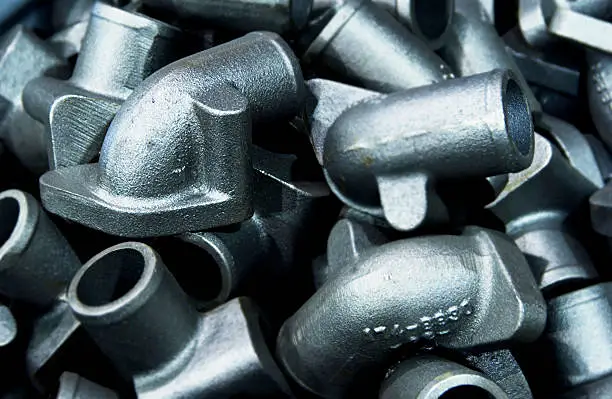
A wax pattern is injected into a metal die, then repeatedly dipped into ceramic slurry to build up a hard shell around it. The wax is melted out, leaving a hollow ceramic mold. Molten metal is poured into that cavity, and once it solidifies, the shell is broken away. What you get is a near-net-shape part that often needs little to no secondary machining.
Investment casting uses two binder systems: silica sol and water glass. Silica sol produces far better surface finish and dimensional accuracy. It is also more environmentally sound than water glass, which relies on alkaline chemistry. For precision applications, silica sol is the industry standard.
The size range is remarkable. Investment casting produces everything from sub-ounce dental brackets to aircraft engine components weighing over 100 pounds. It works with virtually any castable alloy: carbon steels, stainless steels, aluminum, brass, and — uniquely — nickel-based superalloys and titanium that no other casting process can handle.
What Is Sand Casting?
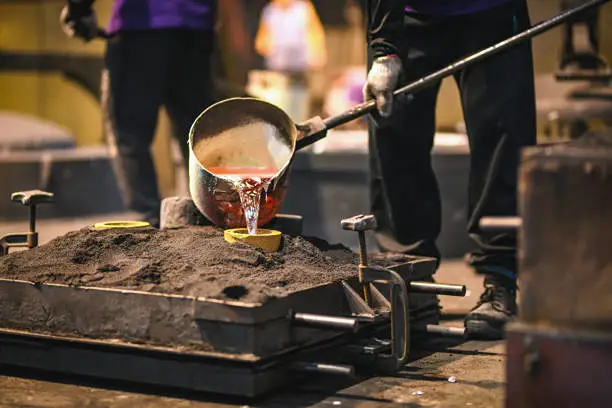
Sand casting is the oldest and most widely used metal casting process. The principle is simple: a pattern (typically wood, plastic, or metal) is pressed into sand mixed with a binder to form a mold cavity. The pattern is removed, the two mold halves are assembled, and molten metal is poured in. After cooling, the sand mold is broken away to reveal the casting.
The sand itself comes in several formulations. Green sand (clay-bonded) is the most common. Resin sand (chemically bonded) gives a better surface finish. Sodium silicate sand (CO2-cured) sits in between. Each offers a different balance of cost, surface quality, and reusability.
Sand casting’s defining advantage is scale. No other casting process handles parts weighing several tons. Engine blocks, pump housings, large valve bodies, and machine tool bases are all classic sand casting applications. Tooling costs stay low — wood patterns can cost a few hundred dollars — and design changes are straightforward. The trade-off: a rougher surface finish, looser tolerances, and the near-certainty that significant CNC machining follows casting.
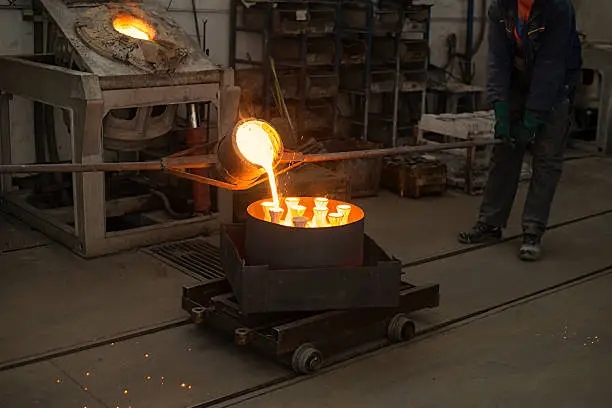
Investment Casting vs. Sand Casting: Key Differences at a Glance
Choosing a casting process comes down to three questions: How precise does your part need to be? What are you willing to spend? How big and complex is the geometry? The table below answers all three, dimension by dimension.
| Dimension | Investment Casting | Sand Casting |
|---|---|---|
| Surface Finish (Ra) | 1.6–6.3 µm (63–125 µin) | 12.5–50 µm (250–500 µin) |
| Dimensional Tolerance | ±0.005″/in (CT4–CT6) | ±0.030″/in (CT10–CT13) |
| Minimum Wall Thickness | 0.5–1.5 mm (0.020–0.060″) | 3–6 mm (0.120–0.240″) |
| Part Size Range | <1 oz to ~100–150 lbs | Ounces to several tons |
| Tooling Cost | $2,000–$30,000 | $500–$20,000 |
| Per-Unit Casting Cost | Higher | Lower |
| Material Range | Any castable alloy (incl. superalloys, Ti) | Iron, steel, Al, brass, bronze |
| Design Complexity | Almost any shape; internal cavities, thin walls, undercuts | Requires draft angles; internal voids need cores |
| Typical Production Volume | 100–10,000+ units | 1–100,000+ units |
| Lead Time (Tooling) | 6–10 weeks | 4–8 weeks |
The numbers tell a clear story. Investment casting dominates on precision, finish, and geometric freedom. Sand casting wins on upfront cost and maximum part size. But this table only tells half the story. Cost is where most engineers get the comparison wrong.
The Real Cost of Casting: Why Price Per Kilogram Is Misleading
The single most expensive mistake in casting process selection is comparing the price of the raw casting rather than the cost of the finished part. A sand casting might cost $3 per kilogram at the foundry gate. An investment casting of the same part might cost $6. The sand casting looks like the obvious winner — until you add the machine shop bill.
Tooling Cost vs. Per-Unit Cost: Where the Break-Even Lies
Tooling is a one-time cost amortized over your production volume. Investment casting dies cost more ($2,000–$30,000 vs. $500–$20,000 for sand casting patterns), but they last far longer: 100,000 to 500,000 cycles for aluminum tooling, compared to 50–500 cycles for a sand casting wood pattern.
At 200 units, sand casting’s lower tooling cost dominates. At 2,000 units, the tooling cost per part is negligible for both processes, and the per-unit machining cost becomes the deciding factor. The break-even typically sits between 300 and 500 units for stainless steel and complex aluminum parts. Below that, sand casting is often cheaper. Above it, investment casting’s near-net-shape advantage takes over.
The Hidden Machine Shop Bill: Secondary Machining Costs
A sand casting arrives rough. Its parting line is visible. Its surface finish measures 12.5–50 µm Ra. Nearly every functional surface — mating faces, bearing seats, seal grooves, threaded holes — requires CNC machining before the part is usable. That machining adds $1.50 to $4.00 per part. For tight-tolerance features (±0.005″), the cost multiplies quickly.
An investment casting, by contrast, arrives with a 1.6–6.3 µm Ra surface finish and tolerances of ±0.005″ per inch as-cast. Most non-functional surfaces are ready to use. Only critical mating surfaces need finish machining.
The math is sobering: a sand casting that needs extensive tolerance cleanup can end up costing three to five times more per finished part than an investment casting of the same component. You are paying for the casting twice — once at the foundry, and again at the machine shop.
As casting metallurgist John Campbell puts it in his “10 Rules for Good Castings,” maximizing near-net-shape is the single most effective lever for reducing total component cost (Campbell, Complete Casting Handbook, 2nd ed., Elsevier, 2015).
Volume Sweet Spots: When Each Process Wins on Total Cost
For parts of moderate complexity in steel or aluminum, here is how the economics typically play out:
| Volume Range | Recommended Process | Rationale |
|---|---|---|
| 1–300 units | Sand casting | Tooling amortization dominates the calculation |
| 300–500 units | Tipping point | Break-even for many stainless steel and complex aluminum parts |
| 500–5,000 units | Investment casting | Near-net-shape advantage outweighs higher casting cost |
| 5,000–25,000 units | Crossover zone — evaluate die casting | Die tooling begins to amortize; investment remains strong for complex geometries |
| 25,000+ units | Die casting (if material allows) | Fast cycle times dominate |
These thresholds shift with material and geometry. Nickel-based superalloys and titanium can only be investment cast. Sand casting cannot meet their metallurgical requirements. Stainless steel strongly favors investment casting: sand casting stainless requires expensive chromite or zircon sand, and oxidation during pouring degrades surface quality. Gray and ductile iron, meanwhile, are natural sand casting materials where investment casting is rarely economical.
How to Choose the Right Casting Process for Your Part
A systematic approach beats intuition every time. Run your part through these four filters, in order, and the answer will reveal itself.
Filter 1: Material — What Are You Casting?
Your material choice is the first and often decisive filter.
If you are casting nickel-based superalloys (Inconel, Hastelloy), titanium, or duplex stainless steels, you have one option: investment casting. These materials demand the ceramic shell’s thermal stability and controlled solidification.
If you are casting gray iron or ductile iron, sand casting is the natural choice. Investment casting iron is technically possible but rarely economical.
If you are casting stainless steel, carbon steel, aluminum, or copper alloys, both processes are viable. Stainless steel strongly favors investment casting: sand casting stainless requires chromite or zircon sand — expensive specialty materials — and the oxidation that occurs during pouring degrades surface quality enough to require heavy post-processing. If strength is your primary concern over geometry, you should also compare forging vs casting.
Filter 2: Size and Weight — How Big Is Your Part?
Investment casting has a practical upper limit around 80–100 kg (175–220 lbs), though most foundries keep it under 50 kg. In the United States, most investment casting facilities top out at 20 lbs, with facilities handling 20–120 lb parts becoming more common. Chinese foundries with larger automated lines regularly produce 100 kg+ investment castings.
Sand casting has virtually no upper weight limit. Parts weighing several tons are routine.
If your part weighs under 5 kg and has thin-walled features, investment casting is almost certainly the right choice. Sand casting simply cannot produce walls thinner than about 3 mm reliably.
Filter 3: Tolerance and Surface Finish — How Precise Does It Need to Be?
This is where the two processes diverge most dramatically. And this is where the cost equation flips.
If your tolerance requirements are ±0.030″ per inch or looser, sand casting is perfectly adequate and more economical.
If you need ±0.005–0.010″ per inch, investment casting becomes the clear winner. Not just because investment casting can hold these tolerances as-cast. Because sand casting cannot, and every surface that needs precision machining adds cost.
Consider the concept of “finished surface ratio.” If 80% of your part’s surfaces need Ra 3.2 µm or better, investment casting delivers a lower total cost because it produces those surfaces as-cast. Sand casting would require machining 80% of the part’s surfaces, erasing its upfront cost advantage many times over.
Investment casting reliably achieves CT4–CT6 tolerance grades per ISO 8062. Sand casting typically falls in the CT10–CT13 range. For critical mating surfaces requiring CT4 or CT5 precision, investment casting is the only practical option.
Filter 4: Volume and Geometry — How Many, and How Complex?
The final filter pulls together volume and geometry.
At low volumes (under 300 units), sand casting’s low tooling cost usually wins — unless your geometry or material pushes you toward investment casting regardless.
At medium volumes (300–5,000 units), investment casting typically delivers the lowest total cost for precision parts. Tooling amortizes and machining savings accumulate.
At high volumes (5,000+ units), evaluate all three processes: sand, investment, and die casting (for aluminum and zinc). Die casting’s fast cycle times dominate above roughly 25,000 units, but investment casting remains competitive if your part has complex internal geometry that die casting cannot achieve.
Geometric factors that push toward investment casting: thin walls (below 2 mm), internal channels, undercuts, fine surface lettering or logos, and parts that would need multiple sand cores. If your sand casting design requires more than three separate cores, the economic case for investment casting strengthens substantially. Each additional core increases mold-making labor and defect risk.
A quick decision summary:
| If your part is… | Start with… |
|---|---|
| Large and simple, with relaxed tolerances | Sand casting |
| Small to medium, with tight tolerances and complex geometry | Investment casting |
| Superalloy or titanium, any size, any complexity | Investment casting |
| Cast iron, large, cost is the primary driver | Sand casting |
| Medium volume (500+), stainless steel, precision surfaces | Investment casting |
Finding a Reliable Investment Casting Supplier
Choosing the right process is only half the decision. The wrong supplier can undo every advantage investment casting offers. Missed tolerances. Late deliveries. Quality surprises that surface only after your parts arrive.
Certifications and Quality Systems: The Non-Negotiable Baseline
Certifications are the first filter in supplier evaluation. The key is understanding what each one actually signals about a foundry’s capability.
ISO 9001 is the baseline. It confirms the foundry has a documented quality management system, but says little about process capability. IATF 16949, the automotive industry’s quality standard, is a different league entirely. It requires statistical process control with a process capability index (Cpk) of at least 1.33 — meaning no more than 63 defects per million opportunities. Only a minority of foundries worldwide hold this certification.
For casting suppliers, environmental and occupational health certifications carry special weight. Casting is a high-emission, high-energy industry. ISO 14001 (environmental management) and ISO 45001 (occupational health and safety) signal that a foundry has invested in compliance and sustainability. In many regions, environmental permits for new casting operations are no longer being issued. Existing certified facilities represent a shrinking, increasingly valuable pool.
For pressure-containing parts destined for the European market, PED (Pressure Equipment Directive) or AD2000 certification is essential.
A practical example: Besser Casting, a China-based precision investment casting manufacturer, holds IATF 16949:2016, ISO 9001:2015, ISO 14001:2015, and ISO 45001:2018 certifications. That combination filters out the vast majority of casting suppliers and signals a foundry that has invested heavily in process control and quality infrastructure. You can review their full certification profile here.
Production Capability Indicators: Beyond the Brochure
Certifications tell you the foundry has systems in place. Production capability tells you whether they can actually deliver your parts on time and to spec.
Three indicators separate serious foundries from the rest:
Automation level. Fully automated shell-making lines are the single best indicator of a high-capability investment casting foundry. Traditional manual shell-building takes roughly seven days and six to seven coats of ceramic slurry. Quality depends on individual operator skill. An automated line completes the same process in 35–36 hours with consistent, repeatable quality. The equipment cost alone — approximately $750,000 per line — means only a small fraction of foundries (estimated at under 1%) have invested in this technology.
In-house testing equipment. A foundry that owns its testing equipment catches quality issues before parts leave the factory. Look for a spectrometer for chemical composition verification (Spectro brand, made in Germany, is the industry benchmark). A coordinate measuring machine (CMM) for dimensional inspection (Hexagon is the gold standard). X-ray or ultrasonic testing for internal defect detection. A salt spray tester for corrosion resistance validation. Equipment presence means the foundry can provide full batch-level chemical composition reports and dimensional inspection reports with every shipment. That capability eliminates expensive incoming inspection on your end.
Material grade coverage. A foundry that has developed and produced over 200 material grades has deep metallurgical expertise beyond following a recipe. It means the foundry can formulate custom alloys — blending base metals with alloying elements to hit precise chemical specifications — rather than being limited to off-the-shelf grades.
One-Stop Service: The Supply Chain Simplifier
For overseas buyers especially, a foundry with in-house CNC machining and surface finishing eliminates the biggest source of supply chain friction: the handoff between casting supplier and machining shop.
When a casting leaves Foundry A and arrives at Machine Shop B, every quality issue becomes a blame game. Was the porosity from the casting process, or did the machining reveal an inherent defect? When casting and machining happen under one roof, there is one accountable party. The foundry designs the casting with machining in mind from the start, reducing setups, fixtures, and rework.
Only about 10% of casting foundries have in-house CNC machining capability. Those that do can typically handle parts up to 800 × 800 × 600 mm with positioning accuracy of ±0.01 mm. Combined with in-house surface finishing — shot blasting, electropolishing, passivation, plating, painting, Dacromet coating, and more — a truly integrated foundry can deliver a finished, assembly-ready part from a single purchase order.
When evaluating a supplier, ask these questions: Does the foundry have CNC machining in-house? What is the largest part they can machine? Are surface finishing processes done internally or outsourced? The answers tell you whether you are dealing with a casting vendor or a manufacturing partner.
Besser Casting’s full catalog of materials, capabilities, and certifications is available for review at bessercast.com. Their engineering team can assess your project requirements directly. If you are also evaluating non-metal plastic parts, see our casting vs molding comparison.
References
- DFMA. “Casting Process Comparison: Sand vs Die vs Investment Casting Costs.” https://www.dfma.com/resources/casting-process-comparison.asp
- Machine Design. “What’s the Difference Between Investment Casting and Sand Casting?” https://www.machinedesign.com/materials/metals/article/21832061/whats-the-difference-between-investment-casting-and-sand-casting
- Campbell, John. Complete Casting Handbook: Metal Casting Processes, Metallurgy, Techniques and Design. 2nd ed. Elsevier, 2015. https://www.sciencedirect.com/book/9780444635099/complete-casting-handbook
- Stainless Foundry & Engineering. “Investment Casting Vs Sand Casting: Differences and Advantages.” https://www.stainlessfoundry.com/news/investment-casting-vs-sand-casting-differences-and-advantages/
- Gamma Foundries. “Differences between Investment Casting and Sand Casting.” https://www.gammafoundries.com/249-differences-between-investment-casting-and-sand-casting/
- Besser Casting. “Quality Certifications.” https://www.bessercast.com/quality/
- Besser Casting. “Investment Casting Process.” https://www.bessercast.com/investment-casting-process/
- Besser Casting. “Contact.” https://www.bessercast.com/contact/
- Besser Casting. Homepage. https://www.bessercast.com/
 English
  Japanese
  German
  Italian