
Forging vs Casting: A Practical Comparison for Engineers and Buyers
What Are Forging and Casting?
Forging and casting are the two most fundamental ways to turn metal into a functional part — and they work in almost opposite directions.
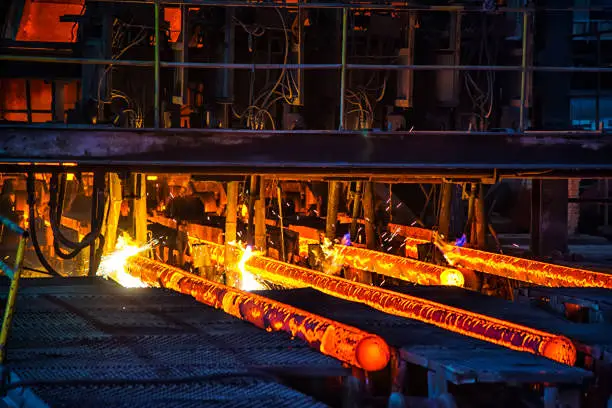
Forging shapes solid metal by applying compressive force. Think of a blacksmith hammering a heated billet into shape: the metal stays solid throughout, deforming plastically under pressure until it takes the desired form. Modern industrial forging uses hydraulic presses or mechanical hammers, but the principle is unchanged.
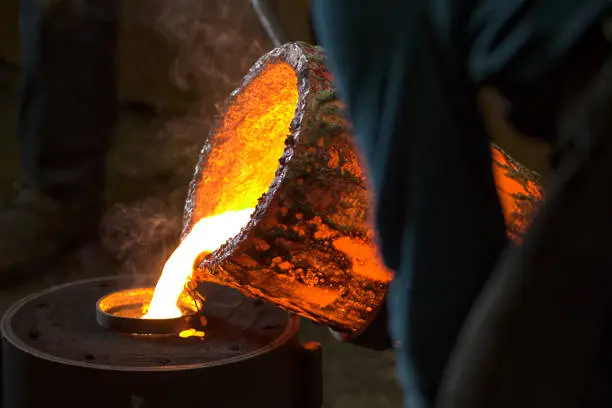
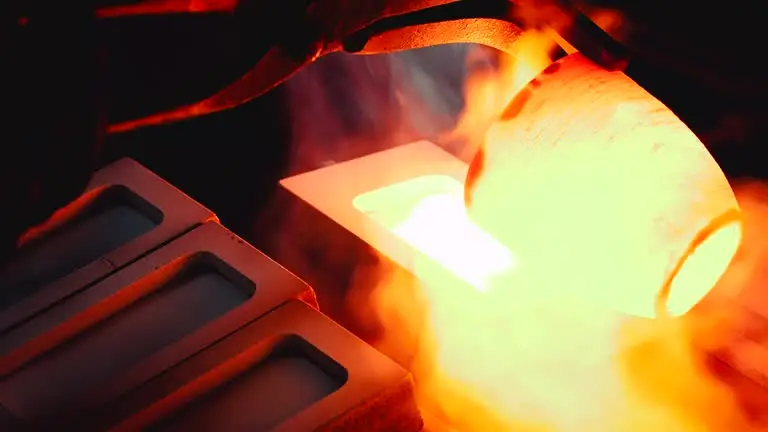
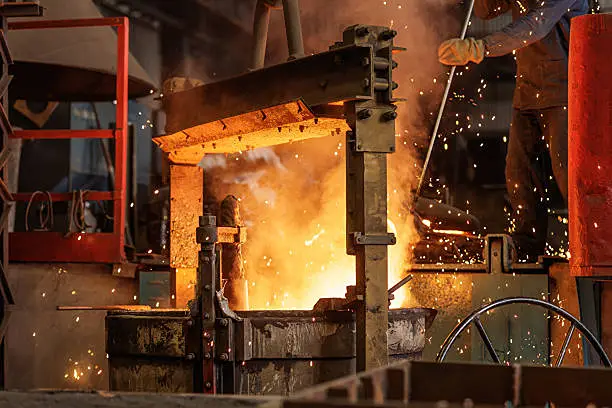
Casting takes the opposite approach: metal is melted into a liquid, poured into a mold cavity, and allowed to cool and solidify. The liquid flows into every contour of the mold, producing the finished shape in a single step.
One distinction matters for everything that follows: “casting” is not one process — it’s a family. Sand casting pours metal into compacted sand molds. Investment casting (also called lost-wax or silica sol casting) builds a ceramic shell around a wax pattern, then burns out the wax before pouring. Die casting injects molten metal into a steel mold under high pressure. Each delivers dramatically different surface finish, precision, and mechanical properties (see our investment casting vs die casting comparison for details). When someone says “castings are weaker than forgings,” they are almost always thinking of sand castings — not investment castings.
With that distinction in place, let’s compare these processes across the dimensions that matter for your part.
Mechanical Properties: Strength, Fatigue, and Grain Structure
The fundamental difference between a forged part and a cast part comes down to what happens inside the metal at the microscopic level. Forging refines and aligns the grain structure. Casting freezes it in place. This single difference cascades into everything else — strength, fatigue life, impact resistance, and how predictably the part will behave in service.
Strength, Fatigue, and Impact Resistance
The numbers tell a clear story. Forged steel parts consistently deliver higher mechanical properties than cast equivalents of the same nominal chemistry:
- Tensile strength: Forged parts are typically 15–26% stronger. A forged 4340 alloy steel part can reach 800–950 MPa, while the same alloy as a casting might achieve 620–750 MPa.
- Yield strength: The advantage is even larger — forged steel shows roughly 35–40% higher yield strength than cast steel, meaning the part resists permanent deformation at higher loads.
- Fatigue life: This is where forging pulls decisively ahead. Research comparing forged steel and cast crankshafts found that forged parts achieved a fatigue strength of 359 MPa at 10⁶ cycles versus 263 MPa for cast equivalents — a 37% advantage that translates to roughly six times longer fatigue life under cyclic loading (SAE International, 2007).
- Ductility: Forged parts exhibit far more plastic deformation before fracture — roughly 58% reduction in area versus only 6% for cast steel. In practical terms, a forged part bends and gives you warning before it fails; a cast part is more likely to fracture without notice.
The engineering reason is straightforward: internal defects. Castings naturally develop shrinkage cavities, gas porosity, and inclusions as the liquid metal solidifies. Every one of these microscopic voids is a potential crack initiation site under cyclic loading. Forging compresses those voids shut, producing a denser, more homogeneous material.
Grain Structure and Directionality
Beneath the property numbers is a microstructural story that explains everything.
When metal solidifies in a mold, it forms a random, coarse dendritic grain structure — crystals growing inward from the mold walls in every direction. The result is isotropic: mechanical properties are the same in all directions, but they are limited by the coarse grain size and the presence of porosity.
When a billet is forged, compressive deformation breaks up those coarse dendrites, recrystallizes them into a fine, equiaxed structure, and — critically — aligns them into a directional grain flow that follows the contours of the part. This grain flow is what gives forgings their characteristic anisotropy: roughly 20–30% higher strength in the longitudinal direction (along the grain) than in the transverse direction (across the grain).
For a crankshaft or a connecting rod, this directional strength is exactly what you want — the grain follows the load path. But for a pressure vessel or a pump housing subjected to multi-axial stress, isotropy can actually be an advantage. A casting’s uniform properties in all directions mean no weak axis you have to design around.
This is not a theoretical nuance. The Steel Founders’ Society of America documented cases where engineers applied forging-level safety factors to cast components, only to discover that the casting’s isotropic behavior made it the safer choice for complex stress states (SFSA, “Castings or Forgings? A Realistic Evaluation”).
Advanced investment casting, combined with hot isostatic pressing (HIP), can close internal porosity and significantly narrow the mechanical property gap with forgings — approaching forged quality for many applications where geometry makes forging impractical.
Design Freedom, Tolerances, and Surface Finish
If mechanical properties are where forging wins, design freedom is where casting dominates — and for many parts, the ability to make the shape at all outweighs incremental strength differences.
Geometric Complexity and Internal Features
Here is a simple test: does your part need internal cavities, tortuous passages, or walls thinner than 2 mm? If yes, forging is probably not an option.
Because forging shapes metal in its solid state, it is fundamentally limited to external geometries. You can forge a gear tooth, a flange, or a shaft — shapes where material moves outward from a center. You cannot forge a hollow valve body with internal flow channels, a pump impeller with undercut vanes, or an engine block with water jackets and oil galleries. The metal simply has nowhere to go.
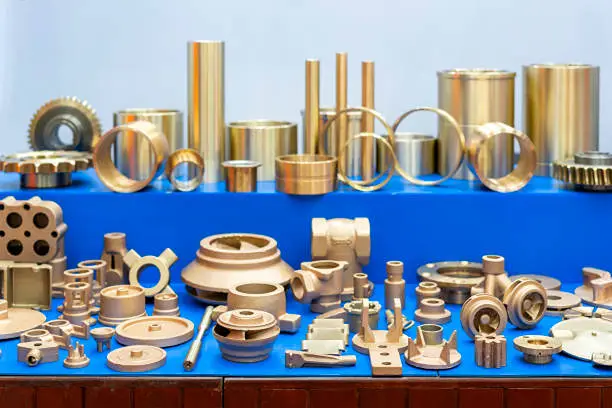
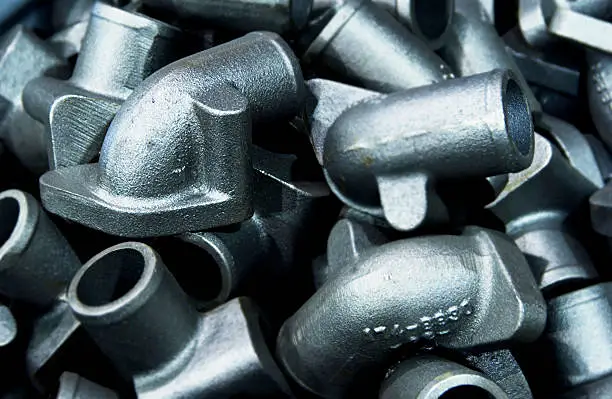
Casting has no such constraint. Liquid metal flows into every void, every undercut, every thin-walled section. Investment casting excels here: the wax pattern can replicate almost any geometry, including threads, serrations, and complex internal cores. A single cast part can replace an assembly of five or more forged, welded, and machined components — consolidating the BOM, eliminating weld inspection, and reducing assembly labor.
The trade-off for forging is that when geometry is simple and strength is paramount — crankshafts, connecting rods, axle beams, gear blanks — the combination of aligned grain flow and near-zero porosity makes it the clear winner.
Dimensional Tolerances and Surface Finish
For precision components, the numbers sharply favor investment casting over forging — and the difference directly affects your machining budget.
| Tolerance Standard | Investment Casting | Closed-Die Forging |
|---|---|---|
| ISO 8062 Grade | CT4–CT6 | CT7–CT9 |
| Typical tolerance at 100 mm | ±0.05–0.20 mm | ±0.20–0.60 mm |
| Surface roughness (Ra) | 1.2–5.0 μm | 5.0–12.0 μm |
Investment casting achieves tolerances 2–4× tighter than closed-die forging and surface finishes 2–4× smoother as-cast. This means less machining, fewer setups, and lower finishing costs — often the dominant factor in total part cost.
In practice, a silica sol investment casting can deliver CT4–CT6 tolerance as standard across the entire part, with critical dimensions reaching CT4 (approximately ±0.05 mm at 100 mm) and a surface finish of Ra 3.2 μm. These are production numbers, not laboratory best-cases — and they are what separate precision foundries from general-purpose casting shops. For buyers evaluating suppliers, a foundry’s ability to hold CT4–CT6 consistently and provide per-batch inspection reports is a reliable proxy for process control maturity (BesserCast precision investment casting capabilities).
Cost and Production Economics
The cost comparison between forging and casting is not a fixed equation — it depends on three variables: annual volume, part complexity, and secondary machining requirements.
| Cost Factor | Forging | Sand Casting | Investment Casting |
|---|---|---|---|
| Tooling cost | $10,000–100,000+ | $3,000–15,000 | $5,000–20,000 |
| Material utilization | 70–90% | 60–75% | 90–95% |
| Unit cost at low volume (100–1,000) | Very high | Low | Medium |
| Unit cost at high volume (5,000+) | Lowest | Medium | Medium-low |
| Design change cost | Very high (new die) | Low (modify pattern) | Medium |
| Typical lead time | 12–20 weeks | 6–12 weeks | 8–16 weeks |
| Break-even volume | 2,000–5,000+ | Any | 500–2,000 |
The pattern is clear: forging wins at high volume with simple shapes, where the expensive die is amortized over thousands of parts. Casting wins at low-to-medium volume and whenever part complexity makes forging impractical — which is most of the time for components with internal features.
How to Choose the Right Process for Your Part
Application Matching: What Goes Where
If you are unsure where to start, looking at what your industry already uses for similar parts is a reliable first filter:
| Industry | Typically Forged | Typically Cast |
|---|---|---|
| Automotive | Crankshafts, connecting rods, steering knuckles, gears | Engine blocks, cylinder heads, transmission cases, turbocharger housings |
| Oil & Gas | Flanges (ASTM A105), small valve bodies, forged fittings | Large valve bodies (A216 WCB), pump housings, compressor cases |
| Aerospace | Landing gear components, turbine disks, structural fittings | Engine casings, complex housings, turbine blades (investment cast) |
| Agricultural | Drive shafts, tillage tools, hitch components | Transmission housings, hydraulic valve bodies, gearbox cases |
| Pump & Valve | Small fittings, stems, seats | Pump bodies, impellers, large valve bodies (A351 CF8M stainless), bonnets |
| Railway | Axles, coupling components | Bogie frames, brake system housings, complex brackets |
A Multi-Factor Decision Framework
Matching by industry gives you a starting point, but every part is unique. Here is a four-step framework for making the call:
Step 1 — Geometry check. Does your part need internal cavities, tortuous passages, or walls thinner than 2 mm? If yes, casting is your only practical option. Forging cannot produce these features.
Step 2 — Load check. Is this a safety-critical component under high cyclic loading, where fatigue failure would be catastrophic? If yes, forging’s superior fatigue resistance and predictable properties make it the safer choice. If loads are moderate or multi-axial, casting’s isotropy may serve you better.
Step 3 — Volume check. Is your annual volume above 5,000 pieces and the shape simple enough to forge? If yes, forging’s die amortization makes it the lowest unit cost. If volume is below 2,000 or the shape is complex, casting will be more economical — investment casting in particular breaks even at relatively low volumes (500–2,000 pieces).
Step 4 — Total cost check. Do not stop at the piece price. Estimate the secondary machining required for each process option. A near-net-shape investment casting that needs only finish-machining on two surfaces can easily cost less in total than a forging that requires CNC work on every face. Factor in inspection costs too — forgings generally require less NDT per batch.
For parts that require complex geometry and reliable mechanical properties at moderate volumes, precision investment casting often occupies a sweet spot between forging’s cost barriers and sand casting’s property limitations. It delivers the design freedom of casting with tolerances and surface finishes that rival machined components — a combination that neither forging nor traditional sand casting can match alone. Beyond metal shaping, if you are also considering plastics, check our casting vs molding guide.
References
- SAE International. “Fatigue Performance Comparison and Life Predictions of Forged Steel & Ductile Cast Iron Crankshafts.” SAE Technical Paper 2007-01-1001, 2007. https://www.sae.org/publications/technical-papers/content/2007-01-1001/
- Steel Founders’ Society of America. “Castings or Forgings? A Realistic Evaluation.” https://www.sfsa.org/subject-areas/education/castingsvforgings/
- BesserCast. “Precision Investment Casting Capabilities.” https://www.bessercast.com/capabilities/
- BesserCast. Homepage. https://www.bessercast.com/
- BesserCast. Contact. https://www.bessercast.com/contact/
 English
  Japanese
  German
  Italian