
Casting vs Machining: Cost, Precision, and Why Most Parts Actually Use Both
If you source metal components, you have almost certainly faced this question: should this part be cast or machined? The short answer is unsatisfying. It depends. But the real answer, the one that experienced manufacturing engineers live by, is more interesting: most production parts use both.
Before we unpack why, let’s get the fundamentals straight.
What Are Casting and Machining, Really?
Casting and machining represent two fundamentally different ways of creating a metal shape. Understanding that difference at the physical level makes every downstream decision clearer.
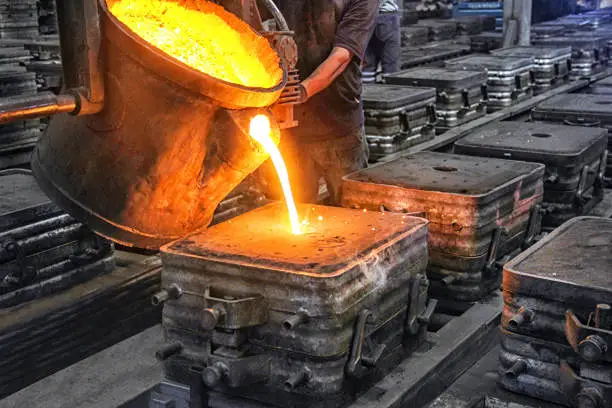
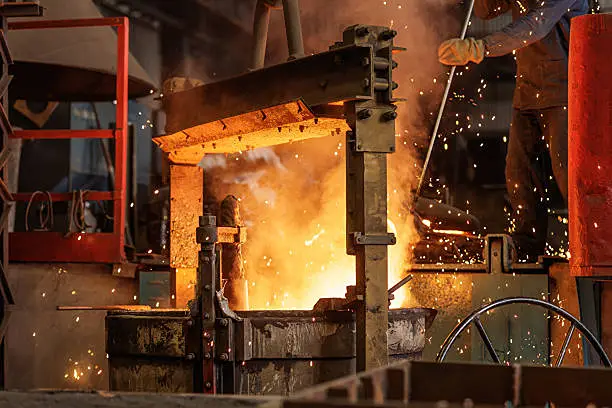
Casting is a formative process. Molten metal is poured or injected into a mold cavity, where it solidifies into a shape that is close to the final part. Think of pouring chocolate into a mold: the liquid takes the mold’s shape, and when it hardens, you have something that needs minimal finishing. In metal casting, this near-net-shape approach means 85 to 95 percent of the material you pour ends up in the finished component. Investment casting, also called lost-wax casting, pushes this further. It can achieve CT4 to CT6 tolerances, meaning a 30 mm feature lands within ±0.1 mm straight from the mold.
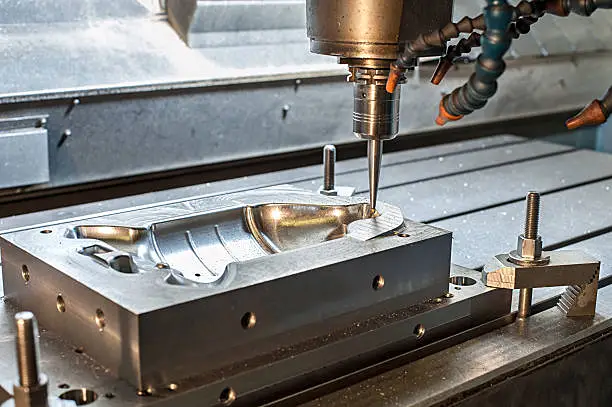
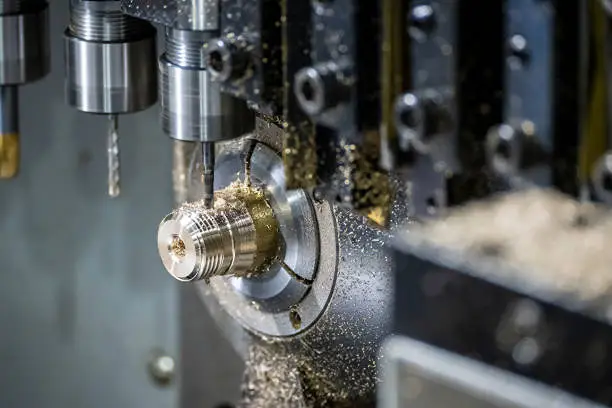
Machining is a subtractive process. You start with a solid block or bar of material — a billet — and cutting tools remove everything that is not the final shape. CNC machining directs these tools with micron-level precision, typically holding ±0.005 to 0.025 mm. The trade-off is substantial: for a complex hollow part like a valve body or pump housing, 70 to 90 percent of the original billet can end up as chips on the floor.
Here is the mental model that serves engineers well: casting creates the shape; machining refines it. The question is not which one is better. The question is where each belongs in your part’s production sequence. If you are also weighing metal against plastic, read our casting vs molding comparison.
Cost at Scale: How Production Volume Changes Everything
Cost drives most casting-vs-machining decisions. But the number that matters is not a fixed per-part price. It is the relationship between volume and cost that tells the real story.
Casting has high fixed costs and low variable costs. The mold or pattern — whether a $2,000 investment casting wax pattern tool or a $50,000 die-casting die — is a one-time expense. Once it exists, each additional part costs relatively little.
CNC machining has low fixed costs and linear variable costs. There is no dedicated tooling. You only need a CAM program and standard fixtures, running $500 to $5,000. But every single part takes roughly the same machine time, material, and labor. The cost curve does not bend downward with volume.
| Cost Factor | Low Volume (1–100 units) | Medium Volume (500–2,000 units) | High Volume (5,000+ units) |
|---|---|---|---|
| Casting per-part cost | $80–500 | $15–80 | $5–30 |
| CNC per-part cost | $50–300 | $50–300 | $50–300 |
| Tooling investment | $2,000–15,000 | $2,000–15,000 | $10,000–50,000+ |
| More economical choice | CNC machining | Gray zone — depends on complexity | Casting |
| Material waste rate (casting) | 5–15% | 5–15% | 5–15% |
The break-even point, where casting’s lower per-part cost finally pays back the tooling investment, is not a fixed number. It depends almost entirely on part complexity. A simple flange with five machining operations might not break even until 3,000 units. A complex motor flange with internal contours can break even at just 43 units.
That 43-unit figure is not theoretical. Grenzebach, a German industrial equipment manufacturer, ran a head-to-head comparison on a motor flange. Machining from solid started with a 10.2 kg blank and ended with a 1.7 kg finished part — 17 percent material utilization. The cast-then-machine route started with a 2 kg near-net-shape blank and produced a 1.5 kg finished part — 75 percent utilization. The casting route became cheaper after just 43 parts.
The practical takeaway: if your annual volume is under 500 units and your part is geometrically simple, CNC machining is almost certainly cheaper. If you are north of 2,000 units, casting is probably winning. Between 500 and 2,000, complexity is the tiebreaker. The more complex your part, the lower the break-even volume.
Precision, Surface Finish, and Mechanical Properties
Cost drives the business case, but precision and performance drive the engineering case. These factors do not all point in the same direction. That tension is exactly why the hybrid approach makes sense.
Tolerance and Dimensional Accuracy
CNC machining owns the tight-tolerance end of the spectrum. Standard CNC milling centers hold ±0.005 to 0.025 mm (IT6–IT7 grade under ISO 286), with premium machines reaching ±0.002 mm. For bearing bores, sealing faces, and threaded holes, this precision is non-negotiable.
But investment casting has closed the gap significantly. Modern silica sol investment casting consistently delivers CT4 to CT6 tolerances per ISO 8062. A 30 mm dimension hits ±0.1 mm straight from the mold. For a typical valve body or pump housing, that means 70 to 80 percent of the part’s features may need no additional machining at all.
The decision turns on a single question: how many of your drawing’s dimensions actually need sub-±0.05 mm precision? If most of them do, CNC is your baseline process. If only a handful of critical interfaces do, you are looking at a cast-then-machine workflow. Cast the complex body, then machine only the sealing faces, bearing seats, and threaded connections. For a deeper dive into how casting methods compare on precision, see our guide to investment casting vs sand casting.
Surface Finish
Surface roughness directly affects sealing performance, fatigue life, and corrosion resistance. Here are the numbers:
- CNC milling typically produces Ra 1.6 to 3.2 µm. That is smooth enough for most industrial applications.
- Investment casting naturally produces Ra 3.2 to 6.3 µm. This is slightly textured, comparable to 80-grit sandpaper.
- Post-process treatments shift both: shot blasting can bring cast surfaces to Ra 1.6 to 3.2 µm, while polishing can push either process below Ra 0.2 µm.
The practical rule: sealing surfaces and mating faces need Ra 1.6 µm or better, which means machining is required. Internal flow passages in pumps and valves, where the cast surface is already smooth enough for fluid dynamics, typically do not need additional finishing.
Mechanical Properties
The common assumption that machined parts are always stronger needs nuance. Yes, machined parts retain the wrought material’s original grain structure and flow lines, giving them 10 to 30 percent higher tensile strength than cast equivalents of the same alloy. But strength is not everything.
Cast parts have a property that machined parts cannot replicate: vibration damping. Cast iron absorbs vibration 10 to 20 times more effectively than steel. This is why machine tool beds, engine blocks, and pump housings are almost universally cast. No CNC program can produce the graphite-flake microstructure that gives cast iron this natural damping characteristic.
The real vulnerability of cast parts is fatigue life. Internal porosity — microscopic voids formed during solidification — can act as crack initiation points under cyclic loading. This is where casting quality control matters most. Proper gating system design, controlled solidification rates, and post-cast heat treatment all directly affect how much porosity survives into the finished part. When fatigue performance is critical, casting process selection and supplier qualification become non-negotiable.
The Hybrid Default: Why Most Production Parts Use Both Processes
Here is the insight that most casting-vs-machining articles mention in a single paragraph and then abandon: in real manufacturing, the question is rarely “cast or machine.” It is “cast, then machine what matters.”
Think of casting as the rough sketch and CNC machining as the fine pen. One gives you 90 percent of the geometry for a fraction of the cost. The other delivers micron-level precision on the surfaces where it counts. The best manufacturers do not pick sides. They use both in sequence.
The Workflow: From Pattern to Finished Part
The cast-then-machine sequence follows a well-established rhythm that is repeated daily in foundries worldwide:
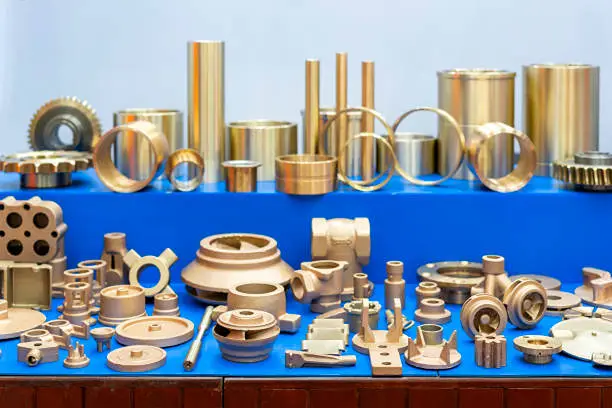
- Pattern and mold creation. Create the near-net-shape mold cavity. This means wax patterns for investment casting, sand molds for larger parts, or permanent dies for high-volume non-ferrous parts.
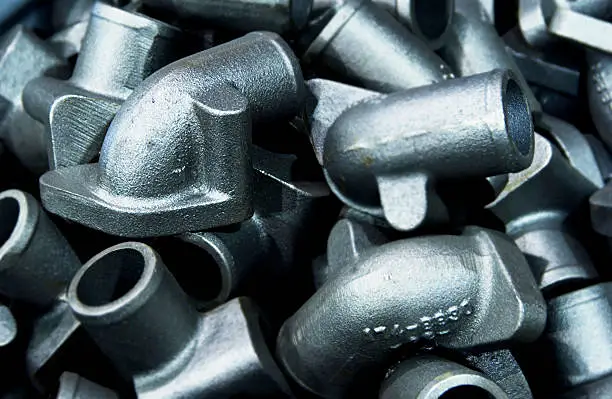
- Casting. Pour and solidify the metal, producing a component that is 85 to 95 percent of the final shape with CT4 to CT6 dimensional accuracy.
- Heat treatment. Eliminate casting stresses through solution annealing, quenching and tempering, or normalizing, depending on the alloy and application.
- CNC finish machining. Machine only the critical features: bearing seats, sealing grooves, threaded holes, and mating surfaces. Typically, only 10 to 30 percent of the part’s total surface area requires CNC work.
- Surface finishing. Apply the specified treatment: shot blasting for general cleanliness, electropolishing for corrosion resistance, passivation for stainless steel, or plating for wear protection.
- Inspection and shipment. Full dimensional inspection with CMM verification, material certification, and documented quality records.
This sequence captures the structural efficiency of casting — complex internal geometry created in seconds rather than hours of CNC programming and cutting — while delivering machining-grade precision exactly where the drawing demands it. It also eliminates the coordination overhead of shipping rough castings to a separate machine shop. When casting and CNC machining happen under one roof, the typical 2 to 4 weeks lost to transport, incoming inspection at the second facility, and communication back-and-forth simply disappears. Foundries that maintain in-house CNC machining centers with documented quality systems spanning both processes can deliver finished parts on timelines that multi-vendor workflows cannot match. For a closer look at how integrated casting and CNC machining capabilities work together, see BesserCast’s overview of their one-stop production workflow.
A Real Cost Comparison: Cast-First vs CNC-Only
Numbers make this real. Take a mid-complexity aluminum hydraulic manifold with internal passages, multiple port faces, and a handful of threaded connections:
| Quantity | CNC-Only Route | Cast + Finish Machine Route | Savings |
|---|---|---|---|
| 100 units | $85 × 100 = $8,500 | $55 × 100 + $3,000 tooling = $8,500 | ~0% (near break-even) |
| 1,000 units | $85 × 1,000 = $85,000 | $22 × 1,000 + $3,000 tooling = $25,000 | ~71% |
| 5,000 units | $85 × 5,000 = $425,000 | $12 × 5,000 + $3,000 tooling = $63,000 | ~85% |
At 100 units, the two routes cost roughly the same. The tooling amortization has not kicked in yet. But at 1,000 units, the cast-then-machine route delivers a 71 percent cost reduction. At 5,000 units, the savings exceed 85 percent. For production volumes, the hybrid approach is not an option. It is the economically inevitable answer.
If you manufacture 3,000 units per year of a product line, the difference between CNC-only and hybrid production can equal the cost of an entire additional CNC machining center. Every single year.
How to Decide: A 5-Factor Framework for Your Part
You have seen the cost curves, the precision data, and the workflow. Now apply it to your part. Instead of asking which process is better (a question with no universal answer), ask these five questions about your specific component:
- Annual volume. Under 500 units? Lean CNC, especially if the design might still evolve. Over 5,000? Casting is almost certainly cheaper, tooling investment included. Between 500 and 5,000? Read questions 2 through 5 carefully.
- Tightest tolerance on the drawing. If any dimension requires better than ±0.05 mm, CNC machining must be involved for that feature. The question then becomes: can you cast the rest of the part and machine only the tight-tolerance features?
- Internal geometry. Does the part have hollow cavities, curved internal passages, or undercuts that a cutting tool physically cannot reach? If yes, casting is your baseline. You cannot machine what you cannot access. Turbine blades with internal cooling channels are the extreme example: they can only be cast.
- Material. Is your alloy readily castable? 300/400-series stainless, carbon steel, aluminum, and nickel alloys like Inconel or Hastelloy all cast well. Tool steels, titanium, and certain specialty grades resist casting. If your material falls in the latter group, CNC machining may be your only viable route.
- Design maturity. Are you still iterating on the design? If yes, stay with CNC. Changing a CAM program takes hours. Modifying a casting mold takes weeks and thousands of dollars. Only commit to casting tooling once the design is frozen and validated.
When Each Process Wins Alone
Some scenarios call clearly for one process over the other.
Pure CNC machining wins when you are building a prototype or a one-off, your tolerances are below ±0.02 mm, you are working with a difficult-to-cast material like titanium or tool steel, or you need a part in 48 hours. Prototyping via CNC is fast, flexible, and carries zero tooling risk.
Pure casting wins when your part has complex internal geometry that no cutting tool can reach, your annual volume exceeds 50,000 units, and your tolerance requirements are moderate (±0.5 mm or looser). Die-cast aluminum housings for consumer products fall squarely in this zone.
The hybrid approach is the right answer for the vast middle ground: medium-to-high production volumes, complex but not extreme geometries, and a handful of critical tolerance features on an otherwise castable part. This describes the majority of industrial metal components — pump housings, valve bodies, impellers, manifolds, brackets, and hundreds of other parts that power manufacturing globally.
Making the Call and Taking the Next Step
If you are still prototyping, stick with CNC. Iterate fast. Do not invest in tooling until the design is locked.
If your design is frozen and your volumes are growing, request a DFM (Design for Manufacturability) review from a casting supplier. A good foundry will analyze your drawing and tell you, before you spend a dollar on tooling, which features can be cast to tolerance, which need finish machining, and how to adjust the design for better castability. These reviews are typically free and take 3 to 5 business days.
If you already know you need both casting and CNC machining, look for a supplier who can handle both processes under one roof. The logistics savings alone — no shipping between facilities, no redundant incoming inspections, no finger-pointing when tolerance issues arise — often outweigh any per-part price difference between vendors. Ask about their in-house CNC capacity, quality certifications, and whether they provide full material traceability and dimensional reports with each batch.
References
- Grenzebach. “Casting Parts vs. Conventional Machining Processing.” Case study. https://www.grenzebach.com/en-us/markets/casting-parts/case-study/
- ProtoLabs. “Machining vs. Casting Decision Depends on Volume.” https://www.protolabs.com/resources/blog/machining-vs-casting-decision-depends-on-volume/
- RapidDirect. “Casting vs Machining: Which One to Choose?” https://www.rapiddirect.com/blog/casting-vs-machining-which-one-to-choose/
- Fictiv. “Casting vs. CNC Machining: How to Choose the Right Process for Your Part?” https://www.fictiv.com/articles/casting-vs-cnc-machining
- BesserCast. “Integrated Casting and CNC Machining Capabilities.” https://www.bessercast.com/capabilities/
- BesserCast. Official Website. https://www.bessercast.com/
 English
  Japanese
  German
  Italian