
Casting Heat Treatment: A Technical Guide for OEM Engineers
Why Castings Need Heat Treatment
A casting fresh from the mold looks finished — but metallurgically, it is not. The as-cast state carries three problems that make heat treatment a requirement, not an option, for any engineered component.
First, internal stress. As molten metal solidifies and cools, uneven shrinkage locks residual stresses into the part — sometimes reaching 70% of the material’s yield strength. Leave these unrelieved, and the casting will warp during machining or crack in service.
Second, the grain structure is coarse and non-uniform. Most as-cast steels grade out at ASTM 0–3 on the grain-size scale — extremely coarse. This translates directly to low toughness, poor fatigue resistance, and unpredictable mechanical behavior.
Third, the microstructure is chemically segregated. Alloying elements don’t distribute evenly during solidification; they form dendritic patterns that create hard and soft zones within the same part. The result: hardness variation that makes precision machining a gamble.
Heat treatment solves all three. Through controlled heating and cooling, it rewrites the metal’s internal structure — relieving stress, refining grains, and homogenizing the microstructure. For most engineering castings covered by standards like ASTM A732 and A985, heat treatment is not optional; it is the step that transforms a raw casting into a qualified component.
Core Heat Treatment Processes for Castings
Choosing the right heat treatment comes down to three questions: Do you need the casting softer or harder? Are you eliminating stress or transforming microstructure? And can your material respond to phase-change hardening? The four processes below cover the answers for 90% of engineering applications.
Annealing and Normalizing — The Softening Spectrum
Annealing heats the casting above its upper critical temperature — typically 790–900°C for carbon steels — then cools it slowly inside the furnace. The result is the softest, most machinable state the material can achieve. It is the go-to choice when extensive CNC work follows casting.
Normalizing follows the same heating cycle but cools the part in still air instead of the furnace. The faster cooling produces a finer grain structure — typically 3–4 ASTM levels finer than as-cast — giving higher strength and hardness than annealing while retaining good machinability.
The decision between the two is straightforward: if you need maximum machinability, anneal. If you need a balance of strength and machinability, normalize.
Quenching and Tempering — Maximum Strength Pathway
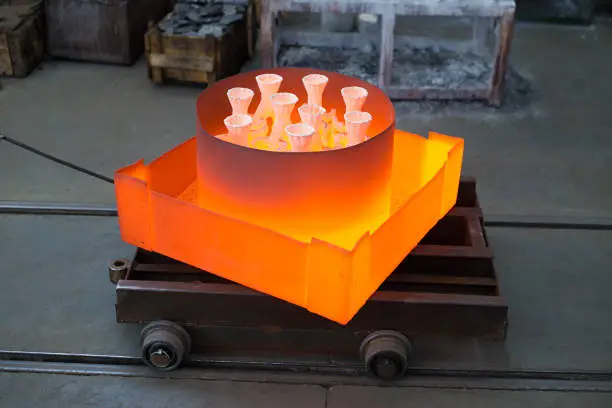
Quenching takes the casting from the austenitizing temperature and cools it rapidly — in water, oil, or polymer — locking the carbon in a distorted crystal structure called martensite. The hardness payoff is substantial: carbon steel castings can reach HRC 55–65 after quenching.
But martensite is brittle. A quenched, untempered casting can fracture under a modest impact. Tempering fixes this: the casting is reheated to a temperature between 150°C and 650°C, held, and cooled. The higher the tempering temperature, the tougher and softer the result. One critical rule: avoid the 250–400°C range, where temper embrittlement can reduce toughness below both the as-quenched and fully tempered states.
For load-bearing components — pump bodies, valve bonnets, excavator brackets — quench-and-temper is the standard path to the required combination of strength and toughness.
Solution Treatment and Aging — Precision Strengthening
Some materials cannot be hardened by martensite formation. Austenitic stainless steels, precipitation-hardening grades like 17-4PH, and aluminum alloys rely on a different mechanism: dissolving strengthening phases into solution at high temperature, locking them in place with a rapid quench, then letting them precipitate in a controlled, fine dispersion through aging.
For 304 and 316 stainless castings, solution treatment at 1,040–1,120°C dissolves chromium carbides that would otherwise cause intergranular corrosion. The key is cooling fast enough through the 850–400°C sensitization window. For 17-4PH, aging at 480°C (H900 condition) produces a tensile strength of approximately 180 ksi — making it a material that competes with quenched-and-tempered alloy steels while offering superior corrosion resistance.
Stress Relieving — The Unsung Hero
Of all the heat treatment processes, stress relieving is the simplest — and the most frequently skipped, often with expensive consequences. The casting is heated to approximately 550°C, held for 2–4 hours depending on section thickness, and cooled slowly.
Stress relieving does not change the microstructure. Its sole purpose is to relax the residual elastic stresses locked in during casting and rough machining. The effect is quantifiable: stress relief annealing can reduce residual stress by 50–60% in alloyed castings, and up to 75–90% in unalloyed gray iron (LangHe Industry, 2025).
Here is the practical consequence: a thin-walled pump housing that skips stress relieving and goes straight to finish machining can warp 0.2 mm out of tolerance. Multiply that by a batch of 500, and the cost of the skipped step becomes clear.
How Heat Treatment Varies by Casting Material
The same furnace can run entirely different cycles depending on what is inside it. A material’s chemical composition determines which heat treatment mechanism is available — and getting this wrong wastes both energy and performance.
Carbon and Low-Alloy Steels — The Heat-Treatable Workhorses
Carbon is the switch that turns on phase-change hardening. The threshold is approximately 0.3% carbon: below this, quenching produces limited hardening; above it, the full quench-and-temper pathway opens.
Low-alloy steels like 4140 and 8630 take this further. A 4140 investment casting, oil-quenched from 850°C and tempered at 600°C, delivers tensile strength in the 900–1,000 MPa range with elongation around 15%. This versatility makes carbon and low-alloy steels the default choice for structural and mechanical castings where heat treatment is the primary property lever.
Stainless Steels — Corrosion Resistance Meets Strength
Stainless steel heat treatment follows a different logic entirely. For the workhorse 300-series austenitic grades, the goal is not hardening — it is dissolving chromium carbides that form at grain boundaries during cooling and welding. Solution treatment at 1,040–1,120°C followed by rapid quenching restores the full corrosion-resistant microstructure.
Precipitation-hardening grades like 17-4PH change the game. Through a solution treatment at 1,040°C plus aging at 480°C, they achieve strength levels comparable to quenched-and-tempered alloy steels while maintaining the corrosion resistance stainless is specified for.
Tool Steels and Nickel Alloys — Extreme Service Materials
When the application demands high-temperature strength, wear resistance, or survival in aggressive environments, the heat treatment window narrows considerably. H13 tool steel requires three tempering cycles at 550°C, each lasting two hours, to convert retained austenite and stabilize dimensions.
Nickel-based alloys like Inconel 718 push control requirements further: a solution treatment at 980°C followed by a two-stage aging cycle — 720°C for 8 hours plus 620°C for 8 hours (Special Metals Inconel 718 Datasheet). These materials also demand vacuum or controlled-atmosphere furnaces to prevent oxidation during treatment.
Common Heat Treatment Defects and How to Prevent Them
Understanding the processes is one thing. Knowing what goes wrong — and why — is what separates a reliable supply chain from a costly one.
Distortion and cracking are the most common and most expensive defects. They happen when heating or cooling rates push past what the casting’s geometry can handle. The risk concentrates at section transitions. A pump body with a flange jumping from 8 mm to 25 mm in wall thickness develops stress concentrations 3–5 times the average during quenching — enough to pull the part permanently out of tolerance. Prevention starts at the design stage with gradual section transitions and generous fillet radii, and extends to process control: ramp rates below 100°C per hour, quenching media matched to the material’s hardenability.
Uneven hardness typically traces to furnace temperature inconsistencies or poor load configuration. If one casting in a batch sits in a cold zone and another near the burner, their properties will diverge. Regular furnace surveys and thermocouple mapping eliminate this variable.
Decarburization and scaling occur when castings are heated in air without protective atmosphere. Carbon bleeds from the surface layer, creating a soft skin 0.5–1.5 mm deep that must be machined away. The fix is straightforward — controlled-atmosphere or vacuum furnaces — but not every foundry has them.
Here is the deeper point: the root cause of heat treatment defects is often not the heat treatment itself. Porosity from inadequate gating, inclusions from dirty metal, shrinkage cavities in heavy sections — these casting defects become failure initiation sites when exposed to thermal stress. A casting that is already compromised cannot be saved by even the most precise heat treatment cycle.
The Integrated Advantage — Why Casting, Heat Treatment, and Machining Under One Roof Matters
Casting, heat treatment, and machining are three steps in the same value chain. In a conventional supply chain, they are split across three different suppliers — each with its own quality system, its own lead time, and its own definition of “acceptable.” The real cost is not in the unit prices. It is in the gaps between them.
Quality Continuity — No Finger-Pointing Between Suppliers
When a machined casting fails inspection, the post-mortem conversation follows a script: the machine shop blames the heat treater, the heat treater blames the foundry, and the foundry asks to see the part. Weeks pass. Root cause stays buried.
Under one roof, there is no one for the foundry to blame. The same quality management system — ideally one certified to IATF16949, which mandates process-level control across the entire production chain — governs every stage. The casting team knows the machining team’s fixture requirements before the first pour. The heat treatment cycle is designed with the final machined dimensions in mind, not just the as-cast properties. Inspection data flows forward: the CMM report from the foundry informs the heat treater’s furnace loading plan, which in turn determines the machining allowance.
This continuity is not theoretical. Foundries that maintain in-house heat treatment and CNC machining under a single quality system eliminate the single largest source of supply-chain quality disputes: the handoff. Besser, for instance, operates 14 CNC vertical machining centers alongside its casting and heat treatment lines, with a single IATF16949-certified quality framework governing the entire process — from raw alloy blend to finished, inspected component.
Lead Time Compression — Cut Weeks, Not Corners
A conventional three-supplier timeline tells the story. Casting: 4 weeks. Transport to heat treater: 1 week. External heat treatment: 1 week. Transport to machine shop: 1 week. Machining: 2 weeks. Total: 9 weeks — and that assumes no queue at any stage, no shipping delay, and no rework loop.
When all three operations sit in the same facility, the casting moves from knockout to heat treatment to CNC without leaving the building. The total timeline compresses to 5–6 weeks. The savings are not in individual process times but in the elimination of transport, queue, and coordination overhead between steps.
Cost Efficiency Beyond Unit Price
Procurement teams trained to compare unit prices often miss the three hidden costs of multi-supplier casting supply chains.
First, management overhead: each supplier requires qualification audits, ongoing quality surveillance, purchase order administration, and periodic re-evaluation. Three suppliers mean three times this load.
Second, logistics: casting parts are heavy. Shipping a 50 kg steel casting three times — foundry to heat treater, heat treater to machine shop, machine shop to your door — adds freight costs that can equal 10–15% of the part price.
Third, and most consequential: the cost of a quality failure that spans suppliers. When a batch arrives non-conforming and three parties are involved, the cost of delay, investigation, rework, and line-down charges at the OEM’s assembly plant dwarfs any unit-price saving.
If the goal is a casting that meets specification, on time, with a single throat to choke when something goes wrong, then integrated manufacturing is not a premium option. It is the lowest-risk path.
 English
  Japanese
  German
  Italian