
If you have ever picked up a valve data sheet or a pump material test report and seen “ASTM A351 CF8M” where you expected to see “316 stainless steel,” you are not alone. The two designations show up side by side in piping specifications, and on the surface they look like different names for the same material. They share roughly 97% of their alloy composition — but the manufacturing process that turns molten metal into a finished part creates differences that matter for your application.
CF8M is the cast equivalent of wrought 316 stainless steel. The “CF” prefix tells you it is a corrosion-resistant casting grade under ASTM A351 (C = corrosion-resistant, F = up to 1.5% silicon for casting fluidity, 8 ≈ 8% nickel, M = molybdenum). Its wrought counterpart is UNS S31600 — the 316 you find in pipe, plate, bar, and forged flanges under ASTM A182 or A312.
But calling CF8M “cast 316” is where the useful comparison begins, not where it ends. The casting process does not just change the shape of the part — it changes the material’s microstructure, and that changes how it behaves in service.
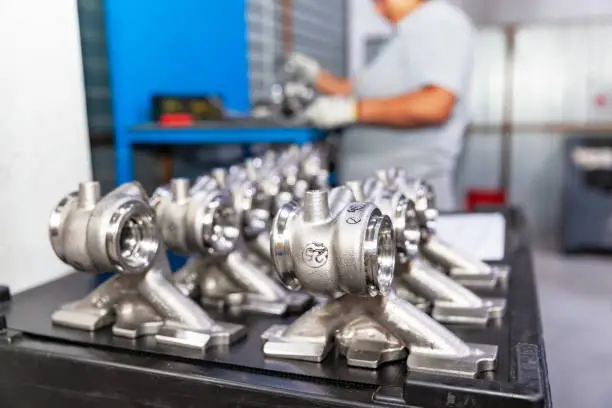
Chemical Composition: Where CF8M and 316 Diverge
At the elemental level, CF8M and 316 are close cousins. The molybdenum content — the defining alloying element that separates both from 304-grade stainless — is identical at 2.0–3.0%. That shared molybdenum content is why both grades offer comparable baseline corrosion resistance in chloride-bearing environments.
But three composition differences exist for a reason, and each one traces back to the casting process:
| Element | CF8M (ASTM A351) | 316 Wrought (A182 F316) | Why the Difference? |
|---|---|---|---|
| Carbon (max) | 0.08% | 0.08% | Same |
| Chromium | 18.0–21.0% | 16.0–18.0% | Wider range compensates for elemental segregation during solidification |
| Nickel | 9.0–12.0% | 10.0–14.0% | Adjusted to balance the higher chromium |
| Molybdenum | 2.0–3.0% | 2.0–3.0% | Identical — this is why corrosion baselines match |
| Silicon (max) | 1.50% | 1.00% | Extra silicon improves molten steel fluidity for filling complex mold cavities |
| Manganese (max) | 1.50% | 2.00% | Slightly tighter in cast grade |
The wider chromium range in CF8M is not a looser specification — it is an engineering response to a physical reality. When molten steel solidifies inside a ceramic mold, the first crystals to form are slightly leaner in chromium than the last. This elemental segregation means different regions of the same casting can have slightly different local chemistry. By setting the minimum chromium at 18% instead of 16%, the specification ensures that even the leanest micro-regions in the casting retain adequate corrosion resistance (ASTM International, A351 standard).
Both grades also have low-carbon variants. CF3M (ASTM A351, ≤0.03% C) is the cast equivalent of 316L (≤0.03% C). If your component will be welded — or if the casting may require weld repair — these low-carbon grades are strongly preferred for reasons we will cover below.
The Ferrite Factor: Why “Cast 316” Is Not Just 316 in a Different Shape
If there is one technical insight worth carrying away from this comparison, it is this: CF8M contains 5–20% delta ferrite in its microstructure, while wrought 316 is essentially 100% austenite. This is not a casting defect. It is an intentional metallurgical feature — and it changes nearly every performance dimension of the material.
Why Ferrite Exists in CF8M — and the Benefits It Brings
When a CF8M casting solidifies, the first phase to form from the melt is delta ferrite (body-centered cubic crystal structure). As cooling continues, most of this ferrite transforms into austenite (face-centered cubic), but a portion — typically 5–20% by volume — remains trapped in the final microstructure.
Foundries do not try to eliminate this ferrite. They need it. Without at least 5% delta ferrite at the end of solidification, the casting is at high risk of hot cracking — the formation of micro-tears along solidification grain boundaries as the part shrinks during cooling. Ferrite acts as a scavenger, absorbing tramp elements like phosphorus and sulfur that would otherwise form low-melting-point films along austenite grain boundaries.
This “necessary compromise” delivers three practical benefits that wrought 316 does not share:
1. Superior resistance to chloride stress corrosion cracking (SCC). This is the most consequential performance difference. In chloride-bearing environments at elevated temperatures, fully austenitic 316 can crack under tensile stress at thresholds as low as approximately 5 ksi. CF8M with 2% ferrite raises that threshold to roughly 15 ksi; with 15% ferrite, it can approach 35 ksi, based on published engineering data (SFSA Steel Castings Handbook, 6th Edition, Blair & Stevens, 1995). The ferrite phase disrupts the crack propagation path that would otherwise travel straight through a fully austenitic grain structure.
2. Higher actual yield strength. While ASTM A351 specifies a minimum yield strength of 205 MPa (30 ksi) for CF8M — identical to the minimum for annealed 316 — production CF8M castings routinely test higher, typically in the 240–290 MPa range. The ferrite phase is inherently stronger than austenite at room temperature.
3. Better weld solidification cracking resistance. For the same reason ferrite prevents hot tearing during casting, it also helps during weld repair — provided the ferrite number remains in the 5–15 FN window.
A practical consequence worth noting: ferrite is magnetic, while austenite is not. If you place a magnet against a CF8M valve body, it will feel a slight pull. This is not evidence of the wrong material — it is evidence of ferrite in the casting, and a properly documented mill test certificate (MTR) will report the measured ferrite number.
The Downside: When Ferrite Works Against You
The ferrite that protects against SCC and hot cracking can become a liability under the wrong conditions.
Selective corrosion. The ferrite phase is leaner in chromium and molybdenum than the surrounding austenite matrix. In aggressive chloride environments — particularly stagnant seawater or acidic chloride solutions — the ferrite phase can corrode preferentially, creating microscopic pits that serve as initiation sites for larger-scale attack. This is why CF8M’s real-world pitting resistance in severe chloride service can fall short of what its PREN (Pitting Resistance Equivalent Number) value of approximately 24–28 predicts. The PREN formula accounts for bulk chemistry only — it is blind to microstructure.
Sigma phase embrittlement. If CF8M is exposed to temperatures between 540°C and 900°C (1,000–1,650°F) for extended periods — as can happen in high-temperature steam systems or during improper heat treatment — the delta ferrite can transform into sigma phase, a hard, brittle intermetallic compound. This severely reduces toughness and ductility. A casting that was ductile at installation can become brittle in service if the operating temperature sits in the sigma-forming range.
Sensitization after weld repair. If a CF8M casting has actual carbon content near the upper limit of 0.08% — which can happen in less tightly controlled melts — and the part undergoes weld repair without a subsequent full solution anneal, chromium carbides can precipitate at ferrite-austenite phase boundaries. The result is a chromium-depleted zone that is vulnerable to intergranular corrosion.
The takeaway: ferrite in CF8M is not a choice — it is a fixed feature of the casting process. The question is whether the foundry controls it within the optimal 5–15 FN window, measures it on every heat, and reports it on the MTR.
Mechanical Properties and Corrosion Resistance: What Changes in the Cast Form
At room temperature, the minimum specified mechanical properties of CF8M and wrought 316 are close enough that they are often treated as interchangeable in static pressure-boundary applications. But the differences become meaningful when you look beyond the specification minimums.
| Property | CF8M (A351, min) | 316 Wrought (A182 F316, annealed) |
|---|---|---|
| Tensile Strength | 485 MPa (70 ksi) | 515 MPa (75 ksi) |
| Yield Strength | 205 MPa (30 ksi) | 205 MPa (30 ksi) |
| Elongation | 30% | 30% |
| Typical Hardness | 130–180 HBW | 160–190 HBW |
| Fatigue Strength | ~280 MPa | 210–430 MPa (varies with cold work) |
| Service Temperature | –254°C to 538°C | –254°C to 538°C |
The strength numbers look similar at the specification level, but the underlying metallurgy tells a more nuanced story. Wrought 316, with its fine, recrystallized grain structure from rolling or forging, typically delivers higher fatigue strength — a meaningful advantage for components that see cyclic loading, such as pump shafts, valve stems, and fasteners. CF8M’s coarse as-cast dendritic grain structure reduces fatigue life under the same loading conditions.
For corrosion resistance, both grades benefit from 2–3% molybdenum, which provides the chloride pitting resistance that separates them from CF8/304 grades. The PREN values are approximately 24–28 for CF8M and 26 for 316 — close enough that neither material has a clear advantage from bulk chemistry alone. However, the presence of ferrite in CF8M, and the casting-specific risks of micro-porosity and elemental segregation, mean that a CF8M casting’s actual corrosion performance depends more on foundry quality control than a wrought 316 component’s does.
For welded or high-temperature applications, the low-carbon variants — CF3M and 316L — are the standard recommendation. Their carbon content of ≤0.03% prevents chromium carbide precipitation during welding or service in the 425–870°C sensitization range.
Making the Right Choice: A Decision Framework for CF8M vs. 316
Knowing the technical differences is half the equation. The other half is knowing when each material makes engineering and economic sense. The choice between CF8M castings and wrought 316 is rarely about which material is “better” — it is about which manufacturing route best serves the part geometry, loading conditions, quantity, and lead time.
As a guiding principle: geometry drives the decision more than any other factor. If your part has a complex internal shape with curved flow passages, multiple port openings, and varying wall thickness — like a valve body, a pump casing, or an impeller — casting is almost certainly the right manufacturing route, and CF8M (or CF3M) is the grade you specify.
When to Choose CF8M Castings
Complex geometries. A valve body with an internal cavity, ribbed walls, and flanged ends would require dozens of machining, welding, and assembly operations to produce from wrought 316 stock. A CF8M casting forms that geometry in a single pour. Near-net-shape casting also means less material waste — an important cost factor when working with molybdenum-bearing stainless steel.
Medium to large production volumes. Casting involves upfront tooling cost — a pattern or die typically costs between $2,000 and $10,000 depending on part complexity and size. This tooling cost gets amortized across the production run. The economic crossover point where casting becomes cheaper than machining from bar stock is typically around 25–50 pieces for moderately complex parts. Below that quantity, machining from wrought 316 bar may be more economical.
Existing tooling. If your supplier already has tooling for a similar part — a common situation when sourcing from established casting foundries — the pattern cost can drop to near zero, making CF8M the clear economic winner even at very low volumes.
When Wrought 316 Is the Better Choice
Fatigue-critical components. Shafts, stems, fasteners, and any part that experiences cyclic stress should be made from wrought 316. Its fine, worked grain structure provides higher fatigue strength and more predictable fatigue life than cast CF8M. This is not a marginal difference — for a rotating pump shaft, the fatigue performance gap is a safety margin.
Small-batch simple shapes. If you need five flanges or ten spacer rings, machining them from standard 316 bar or plate stock avoids tooling costs entirely. The per-part machining cost will be higher, but with no pattern investment to amortize, the total project cost is lower.
Cryogenic service below –100°C. Fully austenitic wrought 316 retains excellent toughness down to cryogenic temperatures. CF8M’s ferrite content can reduce impact toughness at extremely low temperatures, though for most industrial cryogenic applications above –196°C (liquid nitrogen), either material performs adequately.
Standard piping components. For pipe, fittings, and flanges that follow standard dimensional specifications, the industry default pairing is well established: ASTM A312 TP316 for pipe, ASTM A182 F316 for forged flanges, and ASTM A351 CF8M for the cast valve bodies that connect them. These pairings are pre-qualified under ASME B16.34, and there is rarely a reason to deviate.
Welding Considerations and Low-Carbon Variants
If your CF8M or 316 component will be welded — whether during original fabrication, field installation, or repair — specify the low-carbon variant: CF3M for castings, 316L for wrought material. The 0.03% maximum carbon content prevents the formation of chromium carbides in the heat-affected zone during welding. Without this protection, carbon and chromium combine in the sensitization temperature range (425–870°C), depleting the grain boundary regions of chromium and creating pathways for intergranular corrosion.
In practice, many quality-focused foundries now control carbon well below 0.03% even when casting to the CF8M specification. When you order CF8M, it is worth asking whether the supplier can provide dual certification to CF8M and CF3M on the material test report. A single sentence in your purchase order — “MTR must show actual carbon content and dual-certify CF8M/CF3M where chemistry permits” — gives you the higher-temperature rating of CF8M with the weldability insurance of CF3M.
Sourcing Quality CF8M Castings: What Engineers and Buyers Should Verify
A material specification is only as good as the foundry that produces it. CF8M is not a commodity where any supplier’s output is equivalent — the casting process introduces variables that wrought 316 does not have, and the difference between a well-made CF8M casting and a poor one can be the difference between a decade of reliable service and a premature failure. When evaluating potential CF8M casting suppliers, here are five dimensions worth verifying:
1. Certifications and quality systems. Look beyond the logo on a website. Ask to see current certificates with their scope of coverage. IATF 16949 and ISO 9001 are the baseline for process-controlled manufacturing. For pressure equipment sold into the European market, PED certification (2014/68/EU) is a legal requirement. Environmental and occupational health certifications such as ISO 14001 and ISO 45001 signal a level of operational maturity that correlates with consistent production quality.
2. Chemical composition control. Does the foundry operate its own spectrometer — such as a Spectro or ARL unit — and test every heat? Is there a documented pre-furnace blending procedure, or does the melt shop adjust chemistry reactively? Foundries that pre-blend charge materials to a calculated target, verify with spectrometer readings, and issue a full chemical analysis with every shipment are operating a fundamentally different level of control from those that melt and hope. Among suppliers that meet this standard, some — such as Ningbo-based BesserCast — complement in-house spectrometer analysis with full MTR documentation per batch, third-party inspection capability, and a quality system audited to both IATF 16949 and PED standards (BesserCast Quality).
3. Ferrite control and nondestructive testing (NDT). Ask whether the MTR includes a measured ferrite number for each heat. A foundry that cannot tell you the FN of its CF8M castings does not control it. For pressure-containing castings, radiography (RT per ASTM E94) or ultrasonic testing (UT per ASTM A609) should be standard options. Dye penetrant (PT) and magnetic particle (MT) inspection are the minimum for surface quality verification.
4. In-house machining and finishing capability. A single-source supplier that casts, heat-treats, CNC-machines, and surface-finishes the part eliminates the finger-pointing that occurs when a casting foundry and a separate machine shop disagree about who caused a defect. Integrated casting-to-finishing operations with multi-axis CNC capability and multiple surface treatment options simplify procurement and shorten lead times (BesserCast Capabilities).
5. Production tracking and delivery reliability. Casting is a serial process — wax → shell → pour → clean → heat-treat → machine → finish → inspect. A delay at any single station delays the entire order. Ask potential suppliers whether they use an ERP system to track production progress in real time, and what their on-time delivery rate has been over the past twelve months. Sample lead times of 25–35 days and bulk order lead times of 30–50 days are typical for a well-organized investment casting foundry.
A casting supplier that can check all five of these boxes — documented certifications, in-house chemical analysis, ferrite measurement and full NDT capability, integrated CNC machining, and real-time production tracking — is operating at a different tier of reliability from the majority of the global supply base.
If you are evaluating casting partners for a CF8M or CF3M requirement and want to benchmark against a supplier that meets the criteria discussed above, the engineering team at BesserCast can provide material test reports, ferrite data, and lead-time estimates for your specific part geometry. Their contact page is at bessercast.com/contact.
References
- ASTM International. “ASTM A351/A351M: Standard Specification for Castings, Austenitic, for Pressure-Containing Parts.” astm.org.
- Davis, Joseph R., ed. “Cast Stainless Steels.” Metals Handbook Desk Edition, 2nd ed., ASM International, 1998, pp. 386–390. asminternational.org.
- ASM Handbook Committee. ASM Handbook, Volume 1: Properties and Selection—Irons, Steels, and High-Performance Alloys. ASM International, 1990. asminternational.org.
- Blair, Malcolm, and Thomas L. Stevens, eds. Steel Castings Handbook. 6th ed., ASM International, 1995. asminternational.org.
 English
  Japanese
  German
  Italian