
Cast Steel vs Forged Steel: A Practical Guide to Process, Performance & Procurement
If you specify metal components for industrial equipment, you have faced this question: should this part be cast or forged? The answer is not as simple as “forged is stronger.” Both processes have their place. Choosing the wrong one costs you — in performance, in lead time, or in budget. This guide walks through the technical differences, the application logic, and the business realities that most comparison articles leave out.
How Cast Steel and Forged Steel Are Made — The Process Difference
The fundamental difference between cast steel and forged steel comes down to one thing: liquid versus solid.
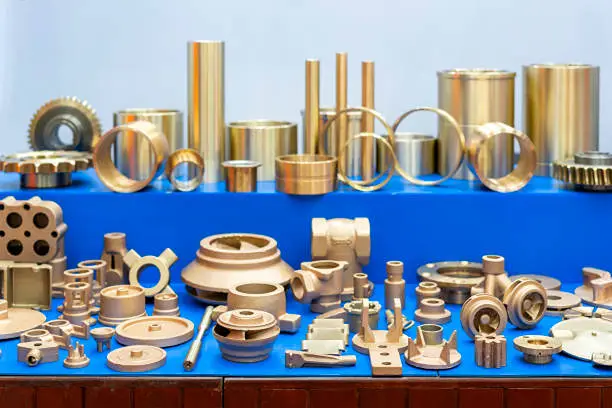
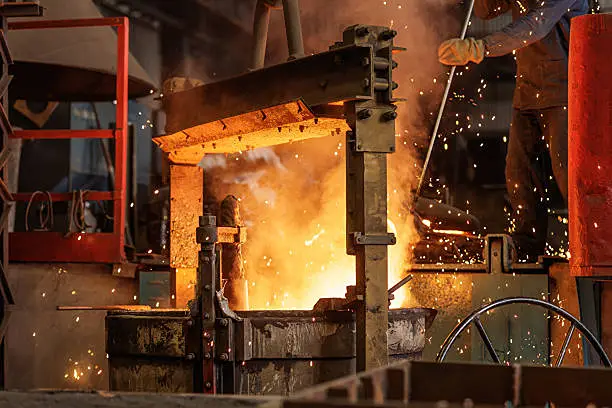
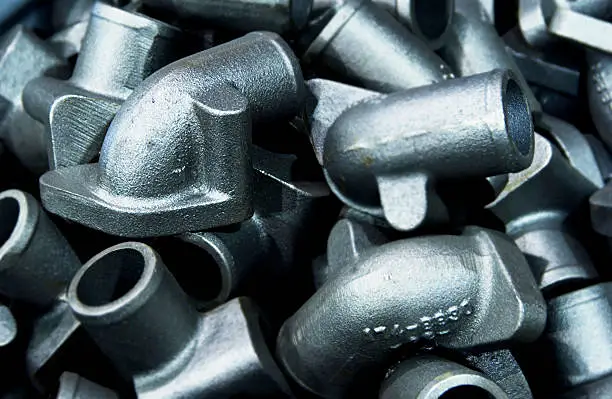
Cast steel starts as molten metal. Scrap steel and alloying elements are melted in a furnace at approximately 1,600°C, then poured into a prepared mold. The liquid metal fills every cavity, cools, and solidifies into the near-final shape. After solidification, the casting goes through shell removal, shot blasting, heat treatment, and machining. Because metal flows as a liquid into the mold, casting can produce extraordinarily complex geometries — internal passages, thin walls, curved surfaces — in a single pour.
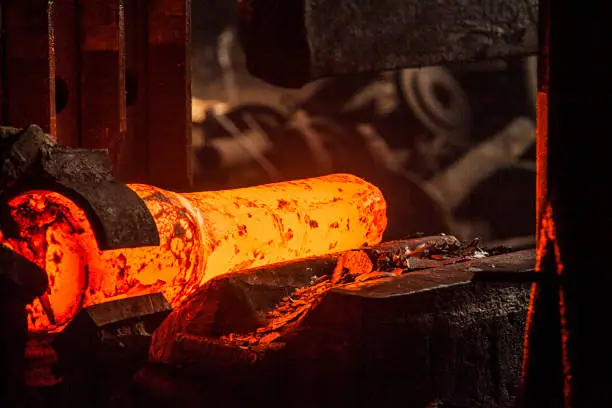
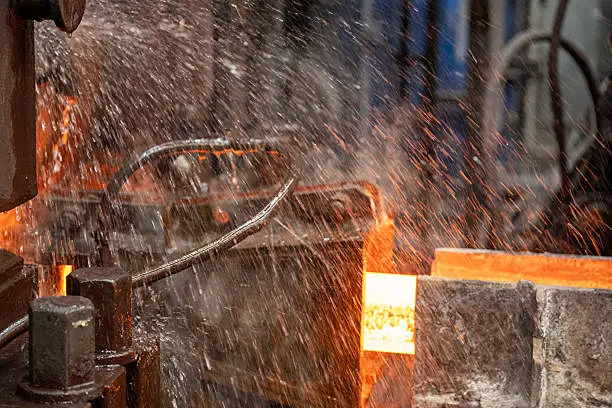
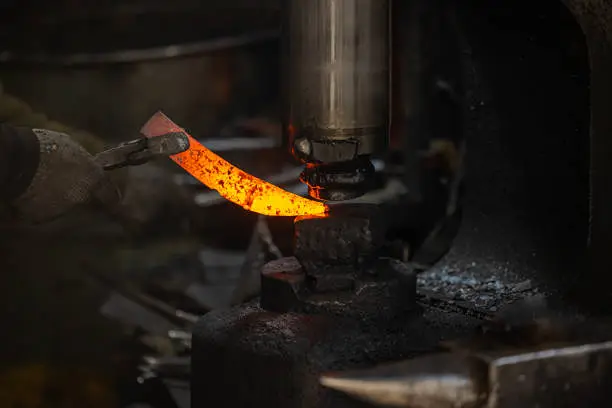
Forged steel starts as a solid billet or ingot. The steel is heated to 1,100–1,250°C and then mechanically deformed under immense pressure — hammered or pressed into shape. The metal never melts; it flows plastically as a solid, its grain structure compressing and realigning with each blow. The forging ratio (typically 3:1 to 5:1) measures how much the cross-section is reduced, and it directly determines how much grain refinement occurs.
Think of it this way: casting is like freezing water in an ice cube tray — the liquid takes the shape of whatever container it’s poured into. Forging is like kneading dough — you apply force to reshape a solid, and the internal structure changes with every fold and press. This core difference — liquid solidification versus solid deformation — explains every property difference that follows.
Grain Structure and Mechanical Properties — Why the Difference Matters
The mechanical performance gap between cast and forged steel is not about chemistry. ASTM A216 WCB (cast carbon steel) and ASTM A105 (forged carbon steel) have nearly identical chemical composition requirements. Yet their mechanical properties diverge significantly. The reason is grain structure.
Grain Structure Deep Dive — Dendritic vs. Directional
When cast steel solidifies, crystals grow along the direction of heat flow, forming tree-like structures called dendrites. These dendrites are coarse, randomly oriented, and often trap microscopic shrinkage cavities between their arms. The result is a grain structure that is isotropic — properties are roughly the same in all directions — but with inherent micro-porosity that reduces toughness and fatigue resistance. A typical cast WCB component has an ASTM grain size of 4–6.
When forged steel is deformed, those coarse dendritic grains are shattered. The repeated mechanical working breaks them into fine, equiaxed grains and then elongates them in the direction of metal flow. This creates what metallurgists call “flow lines” — a directional grain structure aligned with the part’s geometry. A forged A105 component typically achieves ASTM grain size 7–9. Finer grains mean more grain boundaries, and more grain boundaries mean higher strength and toughness.
The trade-off is anisotropy: forged steel is 10–15% stronger along the flow lines than across them. Cast steel, for all its internal imperfections, is genuinely isotropic. In applications where multi-axial stress states dominate, this matters.
Mechanical Properties Head-to-Head — The Numbers
The table below compares typical mechanical properties for equivalent carbon steel grades in cast and forged conditions:
| Property | Cast Steel (A216 WCB) | Forged Steel (A105) | Difference |
|---|---|---|---|
| Tensile Strength | ~485 MPa | ~485 MPa | Comparable |
| Yield Strength | ~250 MPa | ~250 MPa | Comparable |
| Elongation | ~22% | ~30% | Forged ~35% higher |
| Reduction of Area | ~35% | ~55% | Forged ~55% higher |
| Impact Toughness (CVN) | Lower & more variable | Higher & more consistent | Forged advantage |
| Fatigue Limit | ~0.35 × UTS | ~0.45–0.50 × UTS | Forged 30–40% higher |
| Anisotropy | Low (isotropic) | Moderate (directional) | Depends on load direction |
The most revealing numbers are elongation and reduction of area — measures of ductility. The 35–55% gap between cast and forged is not subtle. This is why forged steel dominates in pressure boundary components: if a part must deform before it fractures, forging provides the safety margin that casting cannot reliably guarantee.
Fatigue performance follows the same pattern. Casting defects — micro-shrinkage, gas porosity, inclusions — act as stress concentrators that initiate cracks. The fatigue life of a cast component can vary by a factor of 3–5 from one part to the next, simply because of defect distribution. Forged components, with virtually zero internal porosity, show far less scatter.
Modern silica sol investment casting narrows the gap. Its finer ceramic shell and vacuum assist produce castings with significantly fewer and smaller defects than traditional sand casting. For many non-safety-critical applications, a well-made investment casting delivers entirely adequate mechanical performance. And the cost and geometry advantages make it the smarter commercial choice.
Cast steel gives you isotropy with porosity. Forged steel gives you directional strength with density. Neither is universally better — the part’s stress state picks the winner.
Where Cast Steel Excels vs Where Forged Steel Wins — Application Guide
There is no universal “better” process. The right choice depends on three factors: geometric complexity, performance requirements, and production volume.
When Cast Steel Is the Right Choice
Casting wins when geometry is too complex to forge or when the alloy is too difficult to deform.
Complex internal cavities. Pump bodies, valve bodies, and impellers contain curved internal flow passages that are impossible to forge. Casting forms these passages directly — the mold includes cores that create the internal void space. Forging cannot replicate this in a single piece.
Very large components. When a valve body exceeds 48 inches in diameter, forging becomes impractical. The press tonnage required to deform a billet that size is enormous, and only a handful of facilities worldwide have the equipment. Casting has no such upper size limit — the mold is built to whatever size the part requires.
Difficult-to-forge alloys. High-nickel and high-molybdenum alloys — Hastelloy C-276, Inconel 625, certain duplex stainless steels — have narrow forging temperature windows, sometimes as small as 50–100°C. Step outside that window and the material cracks. Casting avoids this problem entirely: the metal is melted and poured, with no solid deformation required.
Small-to-medium batch production. Investment casting tooling (a wax-pattern die) costs $1,000–$5,000 for a typical small-to-medium part. Closed-die forging tooling for the same part costs $15,000–$80,000. At volumes below 5,000 units per year, the casting tooling amortization advantage is decisive.
When Forged Steel Is the Right Choice
Forging wins when strength, fatigue life, or pressure integrity is the primary design requirement.
Pressure boundary components. Flanges, small-bore valve bodies (<2 inches), and pipe fittings in high-pressure service are overwhelmingly forged. ASTM A105 flanges are rated to Class 2500 (~42 MPa working pressure); cast flanges typically top out at Class 600. The zero-porosity structure of forgings gives pressure-boundary designers a confidence margin that castings, with their inherent micro-voids, cannot match.
Fatigue-critical parts. Crankshafts, connecting rods, gears, and axles — anything that experiences millions of cyclic loads — relies on forging’s superior fatigue performance. A forged crankshaft can deliver 2–3× the fatigue life of an equivalent cast part. The directional grain flow is deliberately aligned with principal stress trajectories during die design, putting the strongest direction exactly where the load path runs.
High-impact applications. Excavator pins, track links, and rock-crusher components absorb sudden shock loads that would fracture a casting. Forged steel’s superior impact toughness, measured by Charpy V-notch (CVN) testing, provides the ductility to deform rather than snap.
High-volume standardized parts. Once annual volumes exceed 5,000–10,000 units, forging’s higher tooling cost is amortized across more pieces, and its faster cycle time (seconds per part versus minutes per casting) drives per-unit cost below casting. This is why standard flanges, elbows, and tees are forged.
Cost, Lead Time, and Production Volume — The Business Reality
Engineers make technical recommendations. Procurement makes purchasing decisions. If you cannot justify your process choice in cost and lead time terms, your technical argument stays on paper.
Tooling cost is the first fork in the road. Investment casting tooling for a mid-size component costs $1,000–$5,000 and can be delivered in 15–20 days. Closed-die forging tooling costs $15,000–$80,000 and takes 4–8 weeks to manufacture. At low volumes, casting’s lower upfront investment wins. At high volumes, forging’s faster per-part cycle time and higher material yield (75–85% versus casting’s 60–70%) flip the equation.
Lead time follows a similar pattern but with a twist. Casting’s total production cycle is longer — the ceramic shell must be built up layer by layer, and each layer must dry before the next is applied. A typical precision casting moves from tooling through first samples in 8–10 weeks. Forging’s cycle is faster once tooling is ready, but the tooling itself takes longer to produce. The net result: casting often delivers first articles sooner, while forging catches up at volume.
To put real numbers on it: a silica sol investment casting foundry serving global OEMs might produce sample castings in 25–35 days from tooling approval, with production quantities shipping in 30–50 days. With safety stock arrangements, lead times can compress to as little as 30 days from order to shipment. These are the operational benchmarks that procurement teams use to evaluate suppliers. When sourcing cast steel components, asking for documented lead time data and on-time delivery history is just as important as reviewing the technical quote. Companies like BesserCast publish their production capabilities online, giving buyers a concrete starting point for supplier evaluation.
Batch size economics differ by region and supplier capability. Chinese investment casting foundries typically serve batch sizes from 50 to 5,000 pieces annually — below the threshold where forging becomes more economical. For projects in this volume range, casting is not just the technically appropriate choice for complex geometries; it is the commercially rational one.
Quality Control and Industry Standards — What to Look For
A comparison of cast versus forged steel is incomplete without understanding the standards that govern each process — and what they tell you about expected quality.
The core standards form a practical reference:
| Standard | Material | Product Form | Typical Application |
|---|---|---|---|
| ASTM A216 WCB | Carbon steel | Cast | Valve bodies & pressure-containing parts |
| ASTM A351 CF8/CF8M | 304/316 stainless steel | Cast | Corrosion-resistant valve & pump components |
| ASTM A487 | High-strength alloy steel | Cast | Heavy-section pressure parts |
| ASTM A105 | Carbon steel | Forged | Flanges, fittings, & small valve bodies |
| ASTM A182 F316/F304 | 304/316 stainless steel | Forged | High-pressure flanges & fittings |
| ASTM A350 LF2 | Low-temperature carbon steel | Forged | Cryogenic service flanges & fittings |
Notice something revealing: A216 WCB and A105 require the same minimum tensile strength (485 MPa) and yield strength (250 MPa). But A105 demands 30% minimum elongation, while A216 WCB requires only 22%. The standards themselves encode the process difference: forgings are expected to be more ductile because their internal structure supports it.
Non-destructive testing requirements diverge by process. Castings are typically inspected with radiography (RT per ASTM E94/E446) to detect internal shrinkage and gas porosity, plus magnetic particle (MT) or liquid penetrant (PT) for surface defects. Forgings rely more on ultrasonic testing (UT per ASTM A388) to detect internal cracks, laps, and non-metallic inclusions. Neither testing regime is “better” — they are matched to the defect types each process tends to produce.
For buyers evaluating casting suppliers, look beyond the standard certificates on the wall. A supplier with their own spectrometer for chemistry verification, CMM for dimensional inspection, and X-ray or UT equipment for internal defect detection operates differently from one that outsources testing. The equipment brands tell you something too — a German SPECTRO spectrometer or a Hexagon CMM represents a level of investment in quality infrastructure that generic equipment does not. Process control certifications like IATF 16949 add another layer of confidence: they mean the supplier measures and controls variation, not just inspects it out at the end.
Cast Steel vs Forged Steel — How to Decide for Your Next Project
You now have the technical data, the application logic, and the business framework. Here is how to put it all together for your specific project.
Four questions to ask before committing to a process:
- How complex is the geometry? If the part has internal cavities, tortuous passages, or walls thinner than 3 mm → start with casting.
- What is the primary failure mode? If the part fails by fatigue (cyclic loading), impact, or pressure burst → forging is the safer default.
- What is the annual volume? Below 5,000 units → casting usually wins on total cost. Above 10,000 units → forging becomes increasingly competitive.
- What alloy are you using? High-nickel, high-molybdenum, and certain tool steels → check the alloy’s forgeability before committing to a forging route.
Quick decision reference:
| Priority | Lean Toward Casting | Lean Toward Forging |
|---|---|---|
| Complex internal geometry | ✅ | ❌ |
| High fatigue / cyclic life | ❌ | ✅ |
| High-pressure boundary | ❌ (unless large size) | ✅ |
| Low-to-medium volume | ✅ | ❌ |
| Tight budget for tooling | ✅ | ❌ |
| Maximum ductility & toughness | ❌ | ✅ |
| Large physical size | ✅ | ❌ |
Modern casting technology has substantially closed the quality gap. Silica sol investment casting can achieve CT4–CT6 tolerances (ISO 8062), surface finishes below Ra 3.2 μm, and wall thicknesses as thin as 0.5 mm in vacuum-cast alloys. Automated shell-building lines have cut production variability — a shell that takes 7 days to build manually can be completed in 36 hours with robotic consistency. That consistency directly reduces the defect rate variability that has historically been casting’s weakness.
The bottom line is not “forged is better” or “cast is cheaper.” It is this: for a given part geometry, performance requirement, alloy, and volume, one process will deliver the better combination of capability, quality, and delivered cost. Your job is to match the process to the requirement — and to find a supplier whose process capability matches what the standard demands.
References
- ASTM International. “ASTM A216 / A216M — Standard Specification for Steel Castings, Carbon, Suitable for Fusion Welding, for High-Temperature Service.” https://www.astm.org/a0216_a0216m-21.html
- ASTM International. “ASTM A105 / A105M — Standard Specification for Carbon Steel Forgings for Piping Applications.” https://www.astm.org/a0105_a0105m-21.html
- ASTM International. “ASTM A182 / A182M — Standard Specification for Forged or Rolled Alloy and Stainless Steel Pipe Flanges, Forged Fittings, and Valves and Parts for High-Temperature Service.” https://www.astm.org/a0182_a0182m-21.html
- ASTM International. “ASTM A351 / A351M — Standard Specification for Castings, Austenitic, for Pressure-Containing Parts.” https://www.astm.org/a0351_a0351m-18.html
- BesserCast. “Production Capabilities.” https://www.bessercast.com/capabilities/
- BesserCast. “Contact.” https://www.bessercast.com/contact/
- BesserCast. “Homepage.” https://www.bessercast.com/
 English
  Japanese
  German
  Italian