
Introduction
Engineers are often confronted with a challenging trade-off in the quest to produce complex geometries versus managing production costs in the quest to produce precision manufacturing. Lost wax casting provides a strong solution to this dilemma, allowing the production of complex components where conventional processes tend to fail. This paper gives a detailed description of the investment casting process, its performance as compared to other methods, and its most important uses in industries so that you can find the best manufacturing solution to your project.
Beyond Traditional Casting: Why Precision Matters
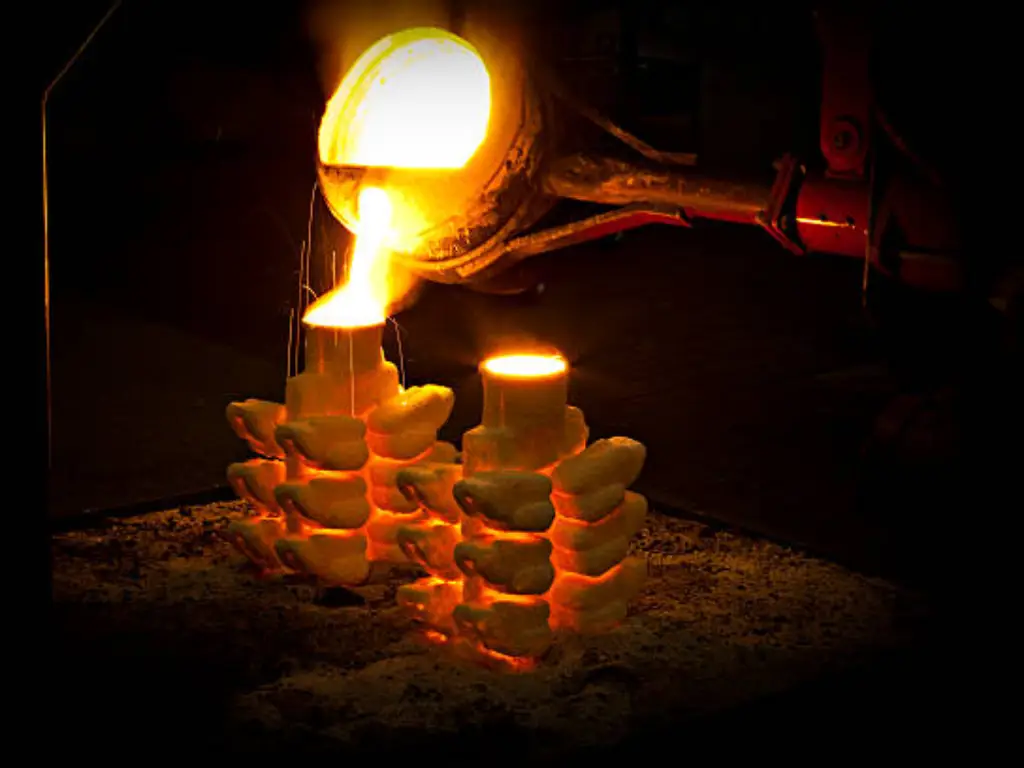
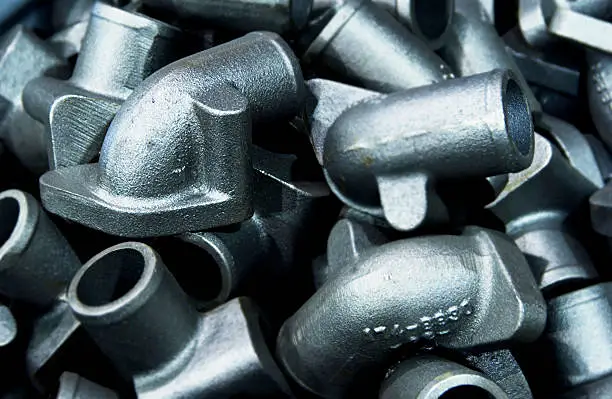
The economic reason why investment casting is chosen among the other manufacturing process alternatives is that it can be used to produce near-net-shape geometry. In traditional sand casting or machining processes, the separation between the raw material input and the final cast part generates significant inefficiencies. This divergence is reduced by precision casting. With the help of a ceramic shell built around a precise wax pattern—often created through high-precision wax injection molding—that targets high dimensional accuracy, manufacturers are able to create metal components with tolerances that strictly restrict the use of secondary machine tools.
This is especially important in other sectors where the cost of materials is high, like in the aerospace industry or in the manufacture of medical equipment. The process is effective in changing the cost structure of the labor-intensive material removal to upfront tooling and process control, which eventually increases the payback of the complex shapes and intricate geometries by minimizing the need for subsequent machining.
Step-by-Step Investment Casting Process
Investment casting is the premier manufacturing route for components requiring high dimensional accuracy (ISO 8062-CT4 to CT6) and complex internal geometries that are impossible to machine.
1. Precision Pattern Engineering & Gating Design
The thermal and mechanical stability of the original pattern determines the quality of the final casting.
- Injection Parameters: Engineers use automated wax injection presses to ensure that injection pressure, flow rate, and dwell time are strictly controlled. In high-complexity components, ceramic or water-soluble cores are incorporated to form complex internal cooling channels or undercuts.
- Material Selection: Professional processes make use of filled waxes (with polymer fillers) to reduce solidification shrinkage and maximize linear dimensional stability.
- Gating System Assembly: The wax tree is not merely a carrier, it is a fluid dynamics system. Gating System Design is a technique used by designers to control the metallostatic pressure and provide a non-turbulent flow. Risers and vents are carefully located to serve as thermal reservoirs, which supply molten metal into the mold during cooling to avoid shrinkage porosity.
2. Multi-Layer Ceramic Shell Construction (The Investment)
The ceramic shell should be able to endure high thermal shock and the pressure of molten metal and be permeable to gases.
- The Prime Coat: The assembly is immersed in a suspension of ultra-fine Zircon flour and a binder. The surface finish (usually to Ra 1.6–3.2 μm) is determined by this layer.
- Intermediate and Backup Layers: The next layers are made with coarser refractory materials such as Mullite or Alumina. The layers are deposited by stuccoing (spraying sand on the wet slurry). An average industrial shell has 5 to 9 layers.
- Controlled Environment: Shell building is done in a Climate-Controlled Room (typically 22°C ± 2°C with 50% ± 5% humidity). Drying is a very important process, and the shell must be dried very carefully; otherwise it will crack; and, conversely, it will delaminate in firing.
3. Flash-De-Waxing and High-Temperature Sintering
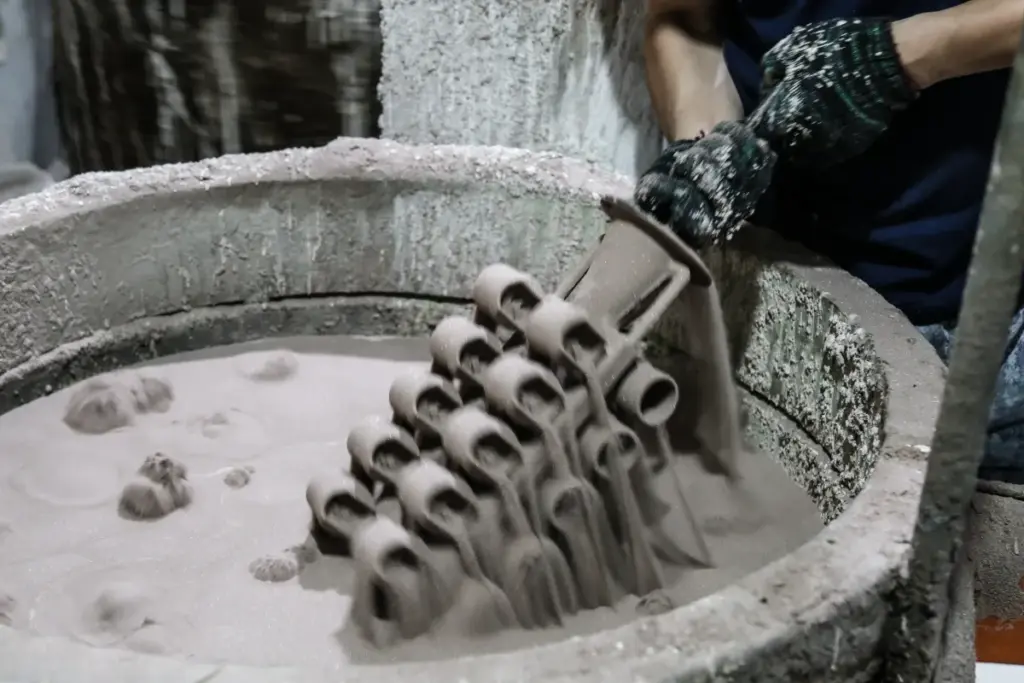
- Autoclave Dewaxing: To prevent the wax from expanding and cracking the ceramic (a common failure mode), shells are placed in a Steam Autoclave. Pressure is ramped to 0.6–0.8 MPa within seconds, flash-melting the wax layer in contact with the shell and allowing it to drain safely.
- Burn-out & Sintering: The empty shells are fired in a furnace from 900°C to 1150°C. This process serves three purposes:
- Removing the residual wax to avoid gas defects.
- Sintering the ceramic particles to increase mechanical strength.
- Pre-heating the mold: Reducing the temperature difference between the metal and the mold to enhance fluidity in thin-walled areas.
4. Metallurgical Melting and Casting Techniques
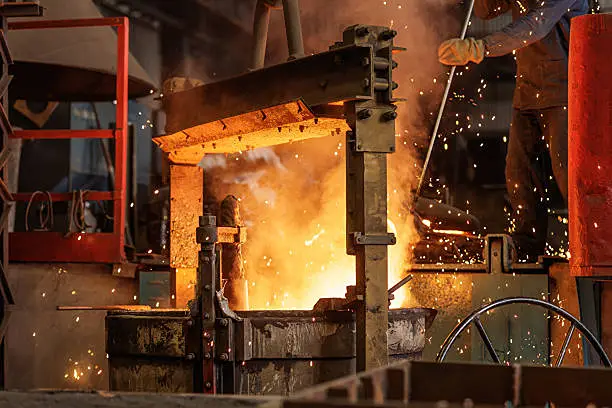
- Atmosphere Control: Depending on the alloy, melting occurs in an air-induction furnace or a Vacuum Induction Melting (VIM) furnace for reactive metals like Titanium or Nickel-based Superalloys.
- Advanced Pouring Methods:
- Gravity Pouring: Most industrial parts are of this standard.
- Vacuum-Assisted Casting: This is applied to ultra-thin walls (sub-1mm) in which vacuum suction is used to force metal into the smallest crevices of the mold.
- Directional Solidification (DS): This is applied in aerospace turbines to remove transverse grain boundaries, producing single-crystal components.
5. Post-Casting: Knockout, Leaching, and NDT
- Mechanical & Chemical Finishing: After solidification, the shell is removed via pneumatic vibration or high-pressure water jetting. For complex internal cavities, the parts undergo Caustic Leaching (boiling in KOH or NaOH) to chemically dissolve the ceramic cores.
- Non-Destructive Testing (NDT):
- Fluorescent Penetrant Inspection (FPI): To detect surface-level micro-cracks.
- Radiographic Inspection (X-Ray): To identify internal inclusions or shrinkage.
- Metrological Verification: Using CMM (Coordinate Measuring Machines) or 3D Laser Scanning to ensure compliance with GD&T (Geometric Dimensioning and Tolerancing) standards.
Selecting Materials
The main benefit of investment casting is that it is virtually unlimited in its metallurgical compatibility. Investment casting, in contrast to die casting, can handle a wide range of alloys, including both from standard carbon steels to exotic superalloys.
The choice of material often dictates the specific ceramic slurry formulation required to prevent chemical reactivity between the molten metal and the mold wall, ensuring metallurgical purity.
Technical Specifications of Common Casting Alloys
| Alloy Category | Common Grades (Standards) | Key Properties & Value Proposition | Primary Applications |
| Stainless Steel | 304/L, 316/L, 17-4 PH, 410 | Superior corrosion resistance, high ductility, and aesthetic finish. | Fluid handling, medical implants, marine hardware. |
| Carbon & Low-Alloy Steel | WCB, AISI 1020, 4140, 8620 | Excellent strength-to-cost ratio; responds well to heat treatment. | Automotive gears, heavy machinery, oil & gas. |
| Tool Steel | A2, D2, H13 | High hardness, abrasion resistance, and toughness at high temperatures. | Industrial cutting tools, molds, and wear parts. |
| Nickel-Base Superalloys | Inconel 625, 718, Hastelloy | Exceptional creep resistance and oxidation stability at $800^\circ\text{C}+$. | Aerospace turbine blades, turbochargers. |
| Titanium Alloys | Ti-6Al-4V (Grade 5) | Extreme strength-to-weight ratio and biocompatibility. | Aerospace structural parts, orthopedic implants. |
| Copper & Aluminum | C83600 (Brass), A356 | High thermal/electrical conductivity and corrosion resistance. | Electrical connectors, heat sinks, marine valves. |
Process Selection: Silica Sol vs. Water Glass Systems
Although the performance of the part is determined by the alloy, the dimensional accuracy and surface integrity is determined by the binding system employed during the shell-building stage. The professional buyers need to choose the process that suits their alloy selection and application needs.
| Feature | Silica Sol Casting (Industrial Standard) | Water Glass Casting (Cost-Optimized) |
| Binder Material | Colloidal Silica (High Purity) | Sodium Silicate (Economy Grade) |
| Surface Finish | Ra 1.6 – 3.2 μm (Smooth/Refined) | Ra 6.3 – 12.5 μm (Rough/Industrial) |
| Dimensional Tolerance | ISO 8062 CT4 – CT6 (High Precision) | ISO 8062 CT7 – CT9 (Standard) |
| Weight Capacity | Best for 0.1kg to 50kg | Best for 10kg to 100kg+ |
| Material Fit | Stainless Steel, Superalloys, Precision Parts. | Carbon Steel, Large Agricultural/Mining parts. |
The selection of binding system is a critical determinant of the structural integrity and accuracy of the end cast component, it is necessary to align with a partner who has mastered these techniques. In order to obtain the above ISO-CT4 levels of precision, Bessercast employs the use of advanced Silica Sol systems with vacuum casting technology. This combination guarantees that your high-complexity parts are not porous with gases, and the ultra-refined surface finish needed in critical industrial applications.
Critical Design Rules
In order to achieve the highest effectiveness of metal casting, engineers should follow the principles of Design for Manufacturability (DFM) peculiar to the investment casting method.
Wall Thickness and Uniformity: Investment casting can be used to cast thin walls, but there is a minimum limit that is based on the fluidity of the alloy and the application of vacuum assist. On the other hand, it is important to avoid huge differences in the thickness of the walls to avoid shrinkage flaws. The thickness of the wall is uniform to provide uniform cooling and reduce internal stress.
Tolerances and Undercuts: The process is known to have tight tolerances. Nevertheless, the maximum accuracy that can be achieved is dependent on the size and geometry of the part. A unique benefit of wax casting is that it is possible to cast undercuts and internal features that cannot be machined. Complex internal channels can be made using soluble wax cores.
Gating and Feeding: Designers have to consider the entry of metal into the mold. The location of gates (where metal gets into the part) influences the end result. Even though they are removed during finishing, they must be on non-critical surfaces to reduce the effects of the later machining.
Investment Casting vs. Alternatives
Investment casting should be compared with other types of casting to help decision-makers to select the most appropriate solution to a particular project.
| Feature | Investment Casting | Die Casting | Sand Casting | CNC Machining |
| Primary Advantage | High complexity & material versatility | Extremely fast production cycles | Low cost for large/heavy parts | High accuracy for simple shapes |
| Material Suitability | Excellent (Ferrous, Non-ferrous, Superalloys) | Limited (Non-ferrous only: Al, Zn, Mg) | Good (Ferrous & Non-ferrous) | Excellent (All machinable materials) |
| Geometry & Undercuts | Best (Intricate details, internal channels) | Limited (Requires draft angles, no undercut) | Moderate (Cores can be used, coarser detail) | Limited (Restricted by tool access) |
| Surface Finish | Superior (Smooth, near-net shape) | Good (smooth but may require trimming) | Rough (Grainy texture) | Excellent (Depends on toolpath) |
| Production Volume | Medium to High | High to Very High | Low to Medium | Low to Medium |
| Tooling Cost | Moderate (Wax injection dies) | High (Hardened steel molds) | Low (Patterns) | Low (None/Jigs only) |
| Material Efficiency | High (Additive-transfer, less waste) | High (Net shape) | Moderate (Runners/gates waste) | Low (Subtractive, high waste) |
The choice of a manufacturing process is hardly a binary decision but a trade-off calculation. Investment casting is in a special “middle ground” that resolves certain engineering contradictions: it provides the geometric freedom of 3D printing with the structural integrity of forged metal, without the material constraints of die casting. Although die casting is the fastest method to use with soft metals and sand casting is the easiest method to use with huge components, investment casting is the undisputed leader in complex, high-tolerance components in ferrous or superalloy. Investment casting offers the best cost-performance balance in projects where internal geometry, material hardness, and surface finish are non-negotiable.
Industrial Applications
| Industry | Specific Applications | Why Investment Casting? |
| Aerospace & Power | Turbine blades, vanes, fuel nozzles, engine casings, structural brackets. | Internal Cooling: Creates intricate internal channels that allow engines to run hotter and more efficiently. |
| Medical & Surgical | Knee/hip implants, surgical clamps, bone plates, dental instruments. | Biocompatibility: Handles difficult-to-machine alloys (Cobalt-Chrome, Titanium) with high precision and sanitation. |
| Automotive | Turbocharger wheels, rocker arms, valve bodies, fuel injection parts. | Weight Reduction: Enables high-durability components with thin walls, improving fuel economy and performance. |
| Industrial / Oil & Gas | Pump impellers, valve internals, drill bits, compressor housings. | Single-Unit Integrity: Casts complex curvatures as one piece, eliminating weak points caused by welding or assembly. |
| Agricultural | Cultivator teeth, seed meters, harvester fingers, knotter components, planter openers. | Precision & Wear: Produces complex soil-engaging shapes using hard-faced alloys that resist extreme abrasion. |
| Railway & Transit | Brake system components, rail clips, door locking mechanisms, overhead line fittings. | Fatigue Resistance: Ensures high structural integrity in safety-critical parts subjected to constant vibration. |
| Defense & Firearms | Trigger mechanisms, receivers, sight mounts, missile guidance fins. | Design Freedom: Allows for ergonomic shapes and high-strength parts that must function in extreme environments. |
| Marine & Naval | Propellers, underwater sensors, deck hardware, pump components. | Corrosion Resistance: Efficiently casts specialized stainless steels and bronzes into hydrodynamically optimized shapes. |
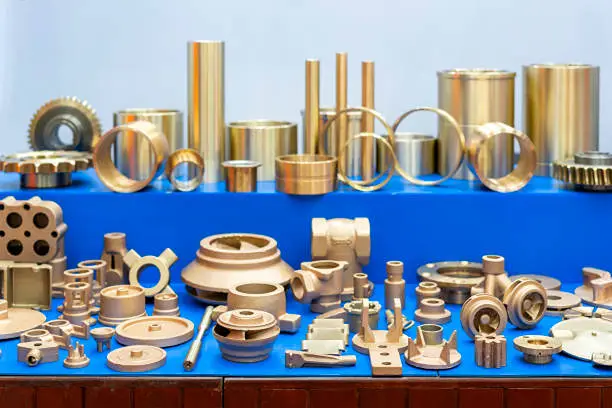
The capability to create precision metal components of exceptional geometric complexity has made investment casting an important manufacturing process in many industries. It has been used in the aerospace industry to make cooling channels in turbine blades, and in medicine to make biocompatible implants of special alloys. Lightweight high-strength components such as turbocharger wheels are also beneficial to the automotive industry. An investment cast part can provide a cost-effective solution to high-performance industries that demand durability, accuracy and structural integrity by providing near-net-shape results, which reduces the amount of additional machining.
Cost Analysis
| Category | Key Cost Factors | ROI & Value Drivers |
| Tooling & Setup | Upfront investment in wax injection dies; higher than sand casting but lower than die casting. | 3D Printing Option: For low volumes, 3D printed patterns can eliminate tooling costs entirely, accelerating ROI for prototypes. |
| Production Volume | Per-unit labor is tied to the efficiency of the “wax tree” assembly process. | Labor Efficiency: High-volume runs reduce per-unit costs; decreased need for secondary machining shortens the total supply chain timeline. |
| Material Utilization | High initial process cost per pound compared to simpler casting methods. | Waste Reduction: Produces “near-net shapes,” significantly saving costs on expensive alloys (Titanium, Nickel) by reducing scrap metal. |
| Secondary Operations | Casting unit price may be higher than raw blanks or sand castings. | Process Consolidation: Significant ROI is achieved by eliminating or reducing expensive CNC machining, drilling, and finishing steps. |
Conclusion
Investment casting is still a pillar of high precision manufacturing. It offers a feasible route to making complex details in high-performance alloys by balancing the cost of tooling and geometric freedom. The technique is essential, whether it is in the form of the growing fuel efficiency of jet engines or the development of surgical instruments, the high dimensional accuracy is achieved by the method. Whether it is water glass in the structural components of cost-sensitive or silica sol in the aerospace components, it is important to know the subtleties of the wax removal, shell building and the choice of alloy. Investment casting provides a reliable, scalable, and accurate route to the best solution of complex metal parts by engineers. Navigating these subtleties requires a manufacturing partner with deep technical expertise. Bessercast provides the advanced vacuum-assisted Silica Sol casting necessary to transform your most challenging designs into high-precision realities. Contact us now!
 English
  Japanese
  German
  Italian